
Part of Speech & Pronunciation
- Part of Speech: Noun (Uncountable)
- Pronunciation:
- UK IPA: /vəˈlɒs.ə.ti/
- US IPA: /vəˈlɑː.sə.t̬i/
- Word Stress: Stress is on the second syllable: ve-LO-ci-ty.
Register & Usage
- CEFR Level: C1 (Advanced)
- Register: Professional, Technical (Physics/Engineering), and Business Strategy.
- Fields of Usage: High frequency in Agile management, Physics, Venture Capital (Capital Velocity), and Personal Productivity.
Core Definition
Velocity is speed in a specific direction. While “speed” just measures how fast something is moving, Velocity measures how fast you are moving toward a goal. In a business and personal context, it represents the rate at which a system or individual produces meaningful results.
Quick Summary: Speed is doing things fast. Velocity is doing the right things fast.
Key Examples of Velocity in Context
The velocity of change increased rapidly.
High execution velocity matters in startups.
The object’s velocity was measured precisely.
Learning velocity determines long-term progress.
1. The Startup Pivot (Feedback Velocity)
Imagine two software teams building an AI-native app.
- Team Speed: Works 80-hour weeks, writes 10,000 lines of code, and releases a “perfect” product after 6 months.
- Team Velocity: Releases a “ugly” prototype in 1 week, gets user feedback, deletes half the code, and pivots.
- The Result: Team Velocity finds the “Product-Market Fit” in month 2, while Team Speed realizes they built something nobody wants in month 6.
- In Context: “Their feedback velocity allowed them to out-compete teams with ten times their funding.”
2. Career Trajectory (Directional Velocity)
Two professionals are “working hard” (high speed).
- Person A: Takes every meeting, answers every email instantly, and helps everyone. They are moving fast but in circles.
- Person B: Declines 90% of requests to focus on a single high-leverage project (like building a proprietary dataset).
- The Result: Person B achieves Escape Velocity — their career takes off because every hour spent was aligned with a single vector.
- In Context: “Don’t confuse your busy schedule with career velocity. One is motion; the other is progress.”
3. Content Distribution (Ship Velocity)
In the 2026 creator economy, “perfectionism” is a velocity killer.
- The Action: Shipping 10 “good enough” videos to test different niches versus spending 3 months on one “masterpiece.”
- The Result: The creator who ships faster finds the “algorithm-market fit” sooner.
- In Context: “We need to increase our ship velocity to identify which content pillar actually compounds.”
4. Personal Finance (Capital Velocity)
This is how wealth is actually built behind the scenes.
- The Action: Instead of just letting money sit, an investor moves capital from an underperforming asset into a high-growth one as soon as the data changes.
- The Result: By increasing the frequency of successful “turns” of their money, they hit their financial goals years earlier.
- In Context: “High capital velocity is more important than high initial investment in a volatile market.”
Velocity Comparison
| Scenario | High Speed / Zero Velocity | High Velocity |
| Meetings | 8 hours of “aligning” and “syncing.” | A 5-minute decision that changes the roadmap. |
| Learning | Reading 50 books but applying none. | Reading one chapter and building a prototype. |
| Fitness | Trying a new “fad” workout every week. | Sticking to a boring program that hits a specific goal. |
| Coding | Writing “clean code” for a feature no one used. | Writing “hacky” code to validate a core hypothesis. |
Velocity in the 2026 Context
In the mid-2020s, the “Speed Trap” has become the primary cause of professional burnout. As AI tools can now generate infinite output (Speed), the only remaining competitive advantage is Direction (Velocity).
Here is how Velocity has redefined success in 2026:
1. Feedback Velocity: The Death of the “Big Launch”
In 2026, we no longer spend months building in secret.
- The Shift: Success is determined by how quickly you can complete the loop: Hypothesis → AI Prototype → User Data → Pivot.
- The Reality: A team with high feedback velocity will out-iterate a billion-dollar corporation. In the time it takes a legal department to approve a memo, a high-velocity founder has already tested three different versions of their product.
2. Decision Velocity as a Skill
Automation has handled the “sorting” of data, leaving humans with only one job: Final Decisions.
- The 2026 Bottleneck: Projects don’t fail because of technical errors; they fail because of “Decision Lag.”
- The Goal: Achieving High Decision Velocity — the ability to make high-quality choices with 70% of the data. If you wait for 100%, your velocity drops to zero while the market moves on.
3. Escape Velocity in the Creator Economy
Distribution is now a commodity. To survive, you need to hit Escape Velocity.
- The Concept: This is the point where your Compounding brand equity becomes stronger than the platform’s algorithm.
- The Result: Once you hit escape velocity, you no longer “chase” views or followers; your existing reputation pulls in opportunities automatically, regardless of platform changes.
4. Intellectual Velocity (AI Augmentation)
In 2026, it’s not about how much you know, but how fast you can synthesize new information.
- The Shift: Using personal AI models to “crunch” 50 books into a customized strategy.
- The Result: This increases your Learning Velocity, allowing you to master a new industry in weeks instead of years.
Strategic Note for 2026: If your AI tools are making you move faster but you feel further from your goals, you have High Speed but Negative Velocity. Stop and recalibrate your vector.
Visualizing Velocity: The Vector Diagram
To truly grasp Velocity, we must see it in action. While “speed” is a scalar quantity (just magnitude), “velocity” is a vector quantity (magnitude AND direction). This diagram illustrates why merely moving fast isn’t enough; you need a clear vector.
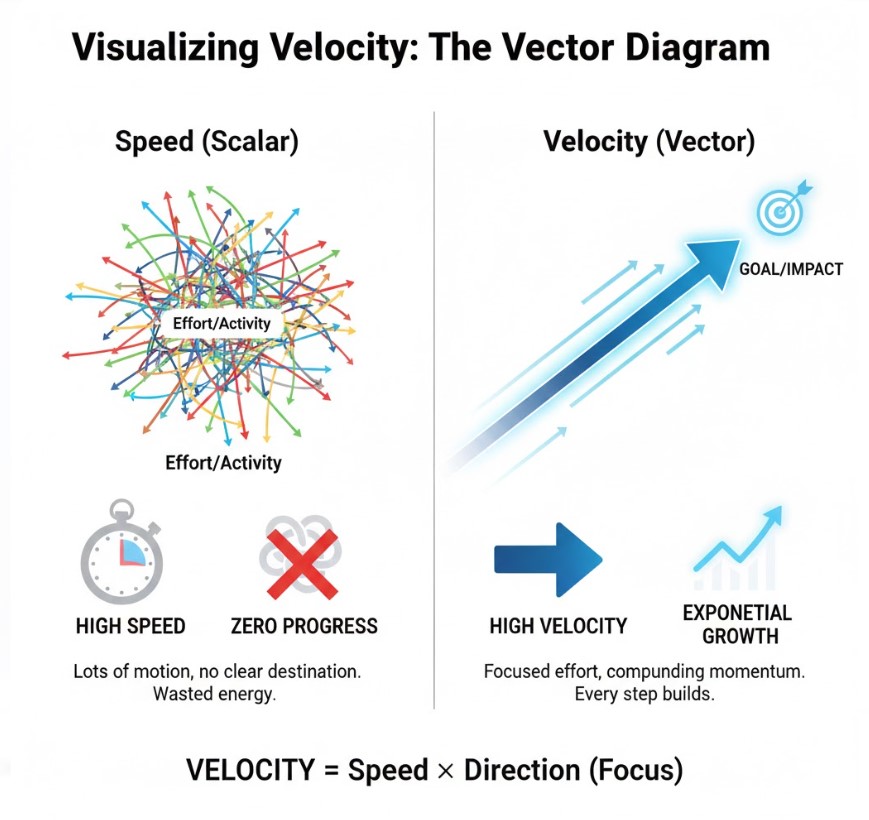
The Strategic Formula: Velocity over Activity
In the modern world, we often confuse motion with progress. The math of success in 2026 isn’t about doing more; it’s about the alignment of your effort.

Why this matters right now:
- The 100x Output: In the age of AI, Speed has become a commodity. Anyone can generate 1,000 emails or 100 images in seconds. This is “High Speed,” but if it’s not pointed at a specific market or goal, its Velocity remains zero.
- The Burnout Trap: High speed without a clear vector leads to “Internal Friction.” You feel exhausted at the end of the day, yet your long-term projects haven’t moved an inch.
- The Inflection Point: Just like with Compounding, Velocity requires a “True North.” When your direction is consistent, every small action (Speed) builds upon the last one, creating massive momentum.
The 2026 takeaway: Most people are trapped in “Circular Speed” — running fast but staying in the same place. To escape, you must stop optimizing for how much you do and start optimizing for where your effort is landing.
Grammar Notes
1. Countable vs. Uncountable
- Uncountable (Abstract Concept): When referring to the general process of growth or accumulation, it is uncountable.
- Correct: “Compounding is a powerful force.”
- Incorrect: “A compounding is a powerful force.”
- As a Gerund (Action): It often acts as the subject of a sentence, describing the act of reinvesting gains.
- Example: “Compounding your knowledge requires daily reading habits.”
2. Adjective vs. Noun: The “Compound” Trap
A common mistake is using Compounding where the adjective Compound is required.
- Compound (Adjective): Describes the result or a specific financial term.
- Correct: Compound interest, Compound effect, Compound fracture.
- Compounding (Noun/Gerund): Describes the ongoing process.
- Correct: “The compounding of these errors led to a disaster.”
Quick Tip: Use Compound for the label (the what) and Compounding for the process (the how). Avoid saying “Compounding interest” — it marks you as a non-native speaker.
3. Transitive Verb Usage: “To Compound”
The verb to compound is transitive, meaning it must act on an object. In 2026, it is frequently used in two distinct ways:
- Positive (Multiplication): To increase or build up.
- Example: “By staying consistent, you compound your influence.”
- Negative (Exacerbation): To make a bad situation even worse (very common in business and crisis management).
- Example: “The CEO’s silence only compounded the PR crisis.”
- Note: Do not use “to” after compound. (Incorrect: It compounded to the problem.)
4. Prepositional Patterns
- Compounding of [Something]: Used when the process is the focus.
- Example: “The compounding of small gains is invisible at first.”
- Compound [Object] with [Something]: Used when mixing or adding elements.
- Example: “The architect compounded traditional styles with 2026 AI-driven design.”
Quick Usage Checklist
| Correct | Incorrect | Why? |
| Compound interest | Compounding interest | Compound is the standard adjective for financial terms. |
| Compounding takes time. | The compounding takes time. | Abstract concepts usually don’t need “the.” |
| It compounded the issue. | It compounded to the issue. | Compound is transitive; it takes a direct object. |
Patterns & Collocations: Velocity in Action
To use “Velocity” like a strategist, you need to know which words it usually “hangs out” with. These common patterns will help you describe growth and progress more accurately.
1. Common Verb + Velocity (Actions)
- To increase/accelerate velocity: To make a process move toward its goal faster.
- “We need to accelerate our ship-velocity to beat the competitors to market.”
- To maintain velocity: To keep the momentum steady without slowing down.
- “The key to compounding is maintaining velocity over long periods.”
- To lose velocity: When a project or trend starts to slow down or lose its direction.
- “The startup began to lose velocity after the initial hype faded.”
- To achieve escape velocity: To reach a point of growth where you no longer need constant effort to keep moving (the “breakthrough” point).
- “Our newsletter has finally achieved escape velocity; it’s growing on its own now.”
2. Adjective + Velocity (Qualities)
- High/Low velocity: The standard way to describe the rate of progress.
- Terminal velocity: In physics, the top speed; in business, the maximum growth rate a company can handle before it breaks.
- “We’ve hit our terminal velocity; adding more staff will actually slow us down.”
- Feedback velocity: How fast you get information back from your actions (the most important metric in 2026).
- “Our feedback velocity is too slow; we are guessing instead of knowing.”
3. Velocity + Prepositional Phrases
- Velocity of [something]: The speed of a specific asset or process.
- “The velocity of money is a key indicator of economic health.”
- At a velocity of [X]: Describing the current rate.
- “The project is moving at a velocity of three major updates per month.”
Velocity in Daily Conversations
In everyday life, most people use the word “speed.” However, by choosing Velocity, you signal that you prioritize outcomes over activity. It’s a linguistic shift from “being busy” to “making progress.”
1. Professional Context: Strategy & Leadership
In business, “Velocity” is the perfect word to use when you want to address a lack of focus without sounding overly critical.
- Instead of: “We are working hard but getting nowhere.”
- Use Velocity: “We have high speed, but our velocity is low because our efforts aren’t aligned.”
- The Scenario: During a team sync or a pivot discussion.“I’m concerned about our decision velocity. If it takes us a week to green-light a simple change, we’ll lose our competitive edge.”
2. Personal Productivity: The “Busy” Trap
Use this to explain why you are prioritizing specific tasks or declining distractions. It sounds more strategic than simply saying you are “busy.”
- Instead of: “I have too much to do.”
- Use Velocity: “I’m protecting my velocity on this project, so I’m saying ‘no’ to any side-tasks for now.”
- The Scenario: When a colleague or friend asks for a favor that would distract you.“I’d love to help, but I need to maintain my ship-velocity this week to hit my deadline. Let’s talk next Monday.”
3. Learning & Self-Development
When discussing new skills, focus on how quickly you are improving and applying knowledge, not just how many hours you’ve spent studying.
- Instead of: “I’m learning this very fast.”
- Use Velocity: “I’m focusing on feedback velocity — applying what I learn immediately so I can correct my mistakes.”
- The Scenario: Discussing a new hobby or a language-learning journey.“My learning velocity really took off once I started using AI tutors for real-time corrections.”
4. Conversation Cheat Sheet
| Situation | What to say | The Impact |
| Breaking through | “We’ve finally hit escape velocity.” | Signals that the project is now self-sustaining. |
| Questioning direction | “We have motion, but do we have velocity?” | A polite way to ask: “Are we actually moving toward the goal?” |
| Urgency | “We need to increase our feedback velocity.” | Focuses on learning and adapting faster, not just working harder. |
When NOT to Use Velocity
Velocity is a strategic and technical term. Overusing it in casual or purely physical contexts can sound pretentious or confusing.
- Simple Physical Movement: If you’re talking about a car, a runner, or a plane without care for its destination, use Speed.
- Incorrect: “The police caught him driving at a high velocity.”
- Correct: “The police caught him speeding.”
- Casual Social Plans: Don’t use it for simple errands or social gatherings.
- Too much: “We need to increase our velocity to get to the cinema on time.”
- Natural: “We need to hurry up.”
- Non-Goal Oriented Activities: If you are relaxing or doing something for fun (like a hobby with no deadline), “velocity” doesn’t apply because there is no “target vector.”
- Avoid: “I’m reading this novel with great velocity.”
Rule of Thumb: If there is no specific goal or directional vector involved, stick to Speed.
Synonyms and Antonyms
Synonyms: Choosing the Right Vector
- Momentum: Often used interchangeably with velocity, but specifically refers to the strength or force gained by motion.
- Use when: The project is already moving and becoming hard to stop.
- Pace / Tempo: Refers to the consistent speed of an activity.
- Use when: Discussing the “vibe” or daily rhythm of work, rather than the final goal.
- Trajectory: The path followed by a moving object.
- Use when: You are focusing more on the future direction than the current speed.
- Impetus: The force that makes something happen or move faster.
- Use when: You are talking about a specific event (like a funding round) that gave the team velocity.
Antonyms: What Stops Progress
- Inertia: The tendency to do nothing or remain unchanged.
- Context: High inertia is the greatest enemy of Decision Velocity.
- Stagnation: A state of not flowing or moving; lack of development.
- Context: “Without a clear vector, our compounding growth has turned into stagnation.”
- Drift: Continuous movement without a fixed control or direction.
- Context: The opposite of velocity. You have speed, but you are just “drifting” aimlessly.
- Friction: The resistance that one surface or object encounters when moving over another.
- Context: In 2026, we focus on removing Friction to maintain high velocity.
Quick Comparison: Velocity vs. Momentum
| Term | Meaning | Focus |
| Velocity | Speed + Direction. | Efficiency: Are we going the right way? |
| Momentum | Mass × Velocity. | Power: Can anything stop us now? |
Conclusion: Focus is the Force Multiplier
In the landscape of 2026, Speed is no longer a primary differentiator — AI and automation have made “fast” the default setting. The real competitive advantage belongs to those who master Velocity.
True mastery lies in where you point your vector. Strategists seek Asymmetry — scenarios where high-velocity effort is directed toward limited downside and uncapped upside.
By understanding that progress is a vector (Speed × Direction), you stop falling into the “Busy Trap.” High velocity ensures that every unit of effort actually feeds into the Compounding engine, creating a self-sustaining cycle of growth rather than a series of disconnected tasks.
The Bottom Line:
- Speed is an activity; Velocity is an achievement.
- Speed burns energy; Velocity builds momentum.
- In a world of noise, Direction is the only signal that matters.
Final Thought: Don’t ask yourself “How much did I do today?” Ask, “At what velocity did I move toward my primary goal?”
FAQ
1. Is Velocity more important than Speed in business?
Absolutely. Speed measures activity (how much you are doing), while Velocity measures progress (how much closer you are to the goal). In 2026, most businesses fail not because they are slow, but because they have high speed in the wrong direction, leading to wasted resources and burnout.
2. How does AI impact Feedback Velocity in 2026?
AI is the ultimate tool for increasing Feedback Velocity. Instead of waiting weeks for market data, you can use AI to run thousands of simulations or analyze customer sentiment in real-time. This allows you to pivot your vector in hours, not months, which is essential for Compounding success.
3. Can you have high Velocity with a small team?
Yes. In fact, small teams often have higher Decision Velocity because they have less Friction (fewer meetings, less bureaucracy). A small team with a clear vector will always outpace a large corporation stuck in “Analysis Paralysis.”
4. What is the “Escape Velocity” of a career?
In professional growth, Escape Velocity is the point where your reputation and personal brand become strong enough to attract opportunities automatically. Once you hit this point, you no longer need to “chase” work; the compounding effect of your previous wins takes over.
5. What is the biggest killer of Velocity?
The biggest killer is Friction—anything from unclear goals to inefficient tools. If you don’t actively remove friction, your speed will eventually drop to zero, regardless of how hard you work.