
Quick Navigation
Core Concepts
Beyond Screen Time: The Evolution of Burnout 2.0
Many people wonder why they feel exhausted even after a weekend off; the answer lies in Digital Burnout 2.0. While we used to blame simple screen time, the reality of Digital Burnout 2.0 is much more complex and invasive
We used to think of digital burnout as simply “spending too much time online.” In the early 2010s, the solution was a “digital detox” — a weekend in the woods without a smartphone. But in 2026, the landscape has shifted. We are no longer just using the internet; we are living inside a persistent, high-fidelity digital layer.
Digital Burnout 2.0 isn’t about screen time; it’s about cognitive sovereignty. It is the exhaustion of the human executive function under the weight of hyper-personalized, AI-driven stimulus.
The Architecture of Exhaustion
Modern fatigue isn’t an accident; it’s a design choice. Unlike the static web of the past, today’s ecosystem operates on “Pre-emptive Content Delivery.” Algorithms don’t wait for you to search; they predict your boredom before you feel it, filling every micro-second of “empty” time.
- The Fragmented Self: We have moved from multitasking to “micro-task fragmentation.” Recent studies on temporal fragmentation from UC Berkeley show that constant digital pings don’t just interrupt work — they fundamentally erode our ability to recover mentally.
- The Context Switch Tax: Every time a notification pulls you from a deep task, your brain pays a metabolic price. Switching between applications hundreds of times a day creates a “hidden cost” that drains human productivity and mental energy far more than the actual workload itself.
- The Death of “Stop Cues”: In the physical world, a book ends and a newspaper has a back page. In the 2.0 world, there are no “stop cues.” Infinite feeds and friction-less scrolling keep the prefrontal cortex in a state of perpetual anticipation, preventing the brain from ever reaching a point of completion.
The Mechanics: Why Your Brain Feels “Fried”
To understand the fatigue, we have to look at the neurobiology of the modern interface.
The Dopamine Loophole: We are evolved to seek novelty. In the physical world, novelty is rare. In the 2.0 digital world, novelty is infinite. This leads to receptor downregulation — where nothing feels interesting anymore, yet we cannot stop scrolling.
| Feature | Impact on Attention | Long-term Result |
| Push Notifications | Constant Task Interruption | Reduced Deep Focus Capacity |
| Short-form Video | Rapid Reward Cycling | Shortened Cognitive Endurance |
| Algorithmic Curation | Loss of Choice Agency | Decision Fatigue |
The Synthetic Mirage: The Illusion of Choice In 2026, we are facing a new phenomenon called “The Synthetic Mirage.” Because AI perfectly tailors our feeds, we are losing the ability to encounter “productive friction” — ideas that challenge us or topics we didn’t know we liked. This creates a cognitive echo chamber. We aren’t burning out from information; we are burning out from the sameness of a world that only reflects our own biases back at us. It’s a monologue disguised as a dialogue, and it leaves the mind feeling hollow and unstimulated despite the constant stream of data.
The Visual Toll of Digital Burnout 2.0
Our brains were never designed to process the sheer volume of high-velocity data we encounter today. This visual and cognitive overload doesn’t just tire our eyes; it rewires our nervous system, creating a permanent state of “alert fatigue.” The image below illustrates the chaotic fragmentation of the modern mind as it struggles to filter the synthetic noise of the 2026 digital landscape.
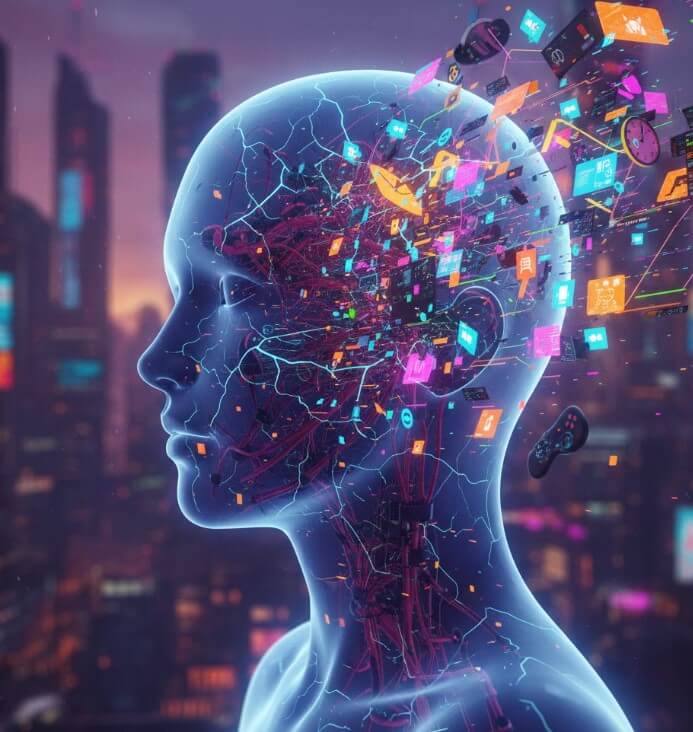
The Biological Impact of Digital Burnout 2.0
To understand why our focus is failing, we must look at how Digital Burnout 2.0 affects our neural pathways and dopamine regulation.
2.0 Strategy: Reclaim Your Bandwidth
One of the fastest ways to lower attention fatigue is to simplify the way you respond. High-level English offers unique tools like Ellipsis and Short Answers to keep your ‘cognitive tax’ low.
Read the full tutorial: The Grammar of Brevity: Mastering Precision in the 2.0 Era
From “Detox” to “Design”
When dealing with Digital Burnout 2.0, traditional methods like a “day without a phone” are no longer sufficient. To truly combat Digital Burnout 2.0, you must redesign your entire digital ecosystem.
In the 2.0 era, “unplugging” is often impossible — our jobs, social lives, and even home utilities are tethered to the cloud. The shift must move from abstinence to architecture.
- Aggressive Curation: Treat your attention like a finite bank account. If an app doesn’t provide high-utility value, it shouldn’t have notification privileges.
- Analog Foundations: Reintroducing “low-dopamine” activities—reading paper books, long-form writing, or tactile hobbies—recalibrates the brain’s reward system.
- Cognitive Offloading: Use AI to filter the noise, not add to it. Let tools summarize the chaos so you only engage with what is essential.
The “High-Friction” Protocol
To combat 2.0 fatigue, you must intentionally re-introduce friction into your life:
- Monotasking Sprints: Set a timer for 25 minutes. During this time, AI assistants and browser tabs are locked. The goal isn’t just work; it’s training your “focus muscle.”
- The “Grey Scale” Barrier: Switch your device display to grayscale. By removing the vibrant, AI-optimized colors, you strip the interface of its psychological “hooks,” making the screen a tool again, rather than a drug.
- Physical Boundaries: Create “Data-Free Zones” in your home where no device with an internet connection is allowed. This forces the brain to switch from “reactive mode” to “reflective mode.”
The “Always-On” Social Tax
Modern burnout is fueled by the invisible expectation of instant availability. In the 2.0 era, being “offline” is often interpreted as being “unproductive” or “unreliable.” This creates a state of Hyper-Vigilance. We are constantly scanning for pings, likes, or mentions, even when we aren’t working. This social anxiety keeps the amygdala — the brain’s fear center — on low-grade alert 24/7, making true recovery impossible even when the screen is dark.
This constant state of hyper-vigilance often leads to what is culturally described as a social breaking point, where the digital noise finally overrides human emotional regulation. To survive the 2.0 era, you must learn to CUT OUT the noise. This applies not only to your notifications and digital habits but to the very way you structure your sentences. Every redundant word is a micro-drain on your energy.
The Verdict
Conclusion: Reclaiming the Human Edge The ultimate irony of 2026 is that as AI becomes more efficient, the most valuable skill a human can possess is the one thing machines cannot replicate: intentional presence. Deep, focused attention is becoming the new high-status luxury. Those who can protect their cognitive sovereignty will lead, while those who cannot will simply be the data points for someone else’s algorithm. The choice is yours: be the architect of your digital life, or be the building material for someone else’s.
Reclaiming your focus isn’t just about productivity; it’s about your personal presence in a world designed to keep you distracted.
FAQ: Navigating the 2.0 Attention Crisis
Is “Digital Burnout 2.0” different from regular stress?
Yes. Traditional stress usually has a clear source — a deadline or a conflict. Digital Burnout 2.0 is a “background radiation” of the mind. It’s a state of chronic cognitive overload caused by a thousand tiny demands on your attention, leading to a feeling of being “busy” without being “productive.”
Can AI help reduce digital burnout, or does it only make it worse?
It’s a double-edged sword. If you use AI to generate more content and noise, it accelerates burnout. However, if you use it as a “Cognitive Shield” — to summarize long threads, filter non-urgent emails, and manage scheduling — it can actually protect your mental energy. The key is using AI to reduce your input, not just increase your output.
Why is a “Digital Detox” no longer effective?
A weekend without a phone is like holding your breath for two minutes and then going back into a room filled with smoke. In 2026, the digital world is too integrated into our lives to simply “quit.” Instead of a temporary detox, you need Systemic Design: permanent changes to how your devices interact with you.
What is the first sign that my “Cognitive Sovereignty” is at risk?
The most common symptom is the “Involuntary Loop.” This is when you find yourself opening an app, closing it, and then immediately opening it again without a conscious reason. It means your habits have bypassed your executive function; the algorithm is now driving your brain.
Is it possible to stay competitive at work while being less “online”?
Ironically, yes. In 2026, “responsiveness” is cheap, but “insight” is expensive. By being less reactive and more focused, you produce the kind of deep work that AI and distracted workers cannot. High-value focus is the ultimate competitive advantage in the modern economy.
Burnout 2.0 Glossary: Understanding Modern Mental Drain
- Micro-Stress Loops — The repetitive, sub-perceptual stress signals triggered by infinite scrolling and “pull-to-refresh” mechanics.
- Context-Switching Tax — The permanent loss of cognitive energy that occurs every time you glance at a notification while working. It’s not just a distraction; it’s a mental penalty.
- The Dopamine Trough — The emotional “low” that follows a high-stimulation session (like watching Reels for an hour). It’s the physiological reason why you feel empty after “relaxing” on your phone.
- Algorithmic Anxiety — The subconscious pressure to keep up with the speed of your feed, fearing that missing a single trend or update will lead to social or professional irrelevance.
- Sensory Overload 2.0 — A state where your brain begins to filter out even important information because the volume of digital input has exceeded its processing capacity.