Alex Vibe | Stealth Identity Consultant • Updated: Feb 2026 • 🌑 Visibility: Zero / Signal: Pure
Navigation hub
In a world of oversharing, the ultimate luxury is the ability to disappear.
Category: Digital Identity & Privacy
Reading Time: 7 minutes
Level: Advanced (C1)
Ten years ago, the rule of the internet was simple: “Pics or it didn’t happen.”
If you went on vacation, you tagged the location. If you got a promotion, you posted a LinkedIn update. If you ate a nice dinner, Instagram knew about it before your stomach did. Visibility was the currency. The more people saw you, the more “successful” you were.
But welcome to 2026. The pendulum has swung back with violent force.
Today, if you scroll through the feeds of the ultra-wealthy or the ultra-smart, you won’t see their faces. You won’t know where they are. You might not even know their real names.
We have entered The Anonymity Renaissance. In an era of AI surveillance, deepfake identity theft, and algorithmic judgment, being “unsearchable” is no longer suspicious. It is the ultimate flex.
The “Dark Forest” of the Internet
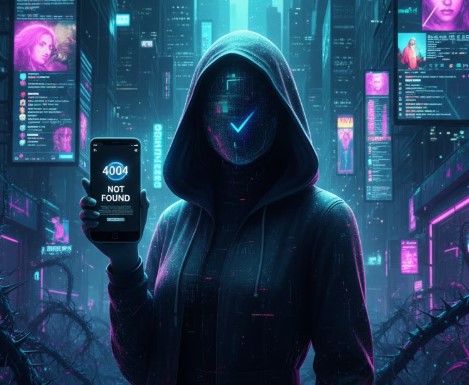
Why is everyone hiding? Because the internet is no longer a town square; it is a “Dark Forest.”
Every photo you upload feeds a facial recognition database. Every comment you write trains a Large Language Model (LLM). Your digital footprint is no longer just a memory; it is raw material for corporations to sell.
Smart professionals have realized that visibility is vulnerability.
- The Old Status Symbol: A Verified Checkmark (Blue Tick).
- The New Status Symbol: A “404 Not Found” page when someone Googles your name.
🛡️ Security Benchmark 2026 “The Cybersecurity & Infrastructure Security Agency (CISA) now recommends ‘digital minimization’ as the primary defense against the identity theft epidemic. It is no longer enough to have a strong password; you must reduce the amount of data that exists about you online.”
Stealth Wealth: The Quiet Luxury of Privacy
Anonymity has become a class issue. Privacy is expensive.
To be fully visible is to be “labor.” Influencers must post to earn money. They are slaves to the algorithm, constantly feeding the beast to stay relevant.
On the other hand, the elite can afford to opt out. They use “dumb phones” on weekends. They have private, encrypted servers. They pay “Digital Erasure” services thousands of dollars to scrub their data from the web.
In 2026, silence is a sign that you don’t need the internet’s approval to survive. As the saying goes: “The loudest person in the room is the one with the most to prove. The quietest is the one with the most power.”
On Stealth Wealth and Privacy: “As reported by The New York Times Style section, the shift toward ‘Quiet Luxury’ isn’t just about fashion; it’s a total withdrawal from the performative digital culture of the last decade.”
The Rise of “Pseudonymity”
Does this mean we stop communicating? No. We just stop using our legal names.
We are seeing a massive shift toward Pseudonymity—operating under a consistent, invented persona. From “VTubers” (virtual avatars) hosting news shows to top-tier coders working under handles like Ghost_Protocol_99, people are separating their biological self from their digital self.
This is healthy. It allows you to express ideas without risking your real-world reputation. It separates your work from your soul.
Career Implications: The “Ghost” Professional
You might ask: “How can I get hired if I’m invisible?”
The job market is adapting. Recruiters in 2026 are less interested in your public performative posting and more interested in your private, verified portfolio.
There is a growing demand for “Ghost Professionals”—strategists, writers, and developers who sign NDAs (Non-Disclosure Agreements) and work in the shadows. They don’t get public credit, but they get paid a premium for their discretion.
Voice of Industry
“We are moving from an era of ‘Public by Default’ to ‘Private by Design.’ In the 2010s, you had to fight to be famous. In the late 2020s, you have to fight to be private. And believe me—privacy is worth fighting for.” — Dr. Elena Soro, Author of The Glass House Generation.
English Learning Toolkit
Master the language of discretion and digital privacy.
1. Buzzwords of 2026
- Stealth Wealth: The practice of being wealthy/successful but hiding it from the public eye (e.g., wearing expensive clothes with no logos, having no social media).
- Doxing: (Legacy term, still relevant) The malicious act of publicly revealing someone’s private personal information.
- Digital Footprint: The trail of data you leave behind when using the internet.
- Opt-out: The active choice to remove yourself from a system or database.
- Dark Social: Private channels of communication (WhatsApp, Telegram, Discord, Email) that public algorithms cannot track or measure.
Challenge: Human or Bot?
Can you spot the difference between a privacy policy written by a lawyer (Human) vs. one generated by AI?
- Option A: “We take your privacy seriously. Your data is processed in accordance with global standards to ensure optimal security protocols are met.”
- Option B: “Look, we don’t want your data. We don’t sell it, we don’t rent it, and frankly, we don’t want the liability of holding it. We delete everything after 24 hours.”
Analysis: Option B is likely Human (specifically, a “Privacy First” founder). It uses informal language (“Look,” “Frankly”) and shows a specific, human motivation (avoiding liability/hassle), whereas Option A is standard corporate “filler.”
The 2026 Slang-Grade
How to sound cool when you are “off the grid.”
| Old School English | 2026 Trend English | Context |
| To go offline | To go dark | Sounds more tactical and intentional. |
| Anonymous | Anon | Short, punchy, used as a noun (“He’s an Anon”). |
| Private account | Walled Garden | Implies a beautiful, curated space that is locked. |
| Delete social media | Nuke the feed | Aggressive removal of all past history. |
Practical Task: The “Erasure” Request
Practice your formal English by writing a request to delete your data.
Task: Write a formal email to a company asking them to remove your personal information. Use the words: Opt-out, Digital Footprint, Compliance.
- Template: “Subject: Data Removal Request. To whom it may concern, I am writing to exercise my right to opt-out of your tracking. Please delete my entire digital footprint from your servers in compliance with 2026 Privacy Laws.”
Community Pulse
How much is your privacy worth to you?
- [ ] I would delete all social media for $1,000.
- [ ] I would delete all social media for $100,000.
- [ ] I would pay money to have my internet history erased.
- [ ] I prefer being visible; it’s good for my career.
Conclusion: The Right to be Forgotten
For twenty years, we ran toward the spotlight. We thought fame would save us. But in a world of infinite noise, the spotlight burns.
The Anonymity Renaissance isn’t about becoming a hermit. It’s about regaining control. It is the decision to share your life only with people who have earned the right to see it.
In 2026, true freedom isn’t being watched by millions. True freedom is walking down the street, knowing that the internet has no idea where you are.
FAQ: The Anonymity Renaissance and Digital Privacy in 2026
Q: Is total anonymity actually legal?
A: In most democratic countries, pseudonymity (using a fake name) is legal for social use. However, for banking, taxes, and legal contracts, you must still prove your identity to the government. The goal of the “Anonymity Renaissance” is not to hide from the law, but to hide from the public and corporations.
Q: What is the difference between “Privacy” and “Secrecy”?
A: This is a common English distinction. Secrecy is hiding something because you are ashamed or doing something wrong. Privacy is hiding something because it belongs to you. You close the bathroom door for privacy, not secrecy. In 2026, we fight for privacy, not secrecy.
Q: Doesn’t hiding hurt my personal brand?
A: Not anymore. Over-exposure is now seen as “cheap.” Scarcity creates value. By sharing less, you make the things you do share more valuable. A blog post from a person who posts once a year is read by everyone. A blog post from a person who posts every day is ignored.
Q: How do I start “Going Dark”?
A: Start with “Data Decoupling.” Separate your accounts. Have one email for “junk” (newsletters, shopping) and a completely different, encrypted email for real friends and banking. Never link them.
Q: Can AI identify me even if I use a pseudonym?
A: Unfortunately, yes. This is known as “Stylometry” or linguistic fingerprinting. Advanced AI can analyze your sentence structure, vocabulary, and even your punctuation habits to link your anonymous account to your real identity. To counter this, many “Anons” in 2026 use “Linguistic Scrubbing”—running their text through AI to rewrite it in a neutral, unidentifiable style.
Q: What is a “Digital Ghost,” and is it a viable career path?
A: A Digital Ghost is a high-level professional (often a consultant, coder, or strategist) who operates without any public social media presence. They rely entirely on “blind trust” networks and private referrals. While it is a difficult path for beginners, it has become a massive status symbol for senior experts who want to avoid Algorithmic Drift and maintain total focus.
Continue Your Journey into the Shadows
True privacy is a puzzle. Now that you understand the Renaissance of Anonymity, explore the technical and psychological blueprints of 2026:
The Mechanics of Disappearing
- Data Decoupling: The Art of Living Between Databases. Learn the practical steps to separating your biological identity from the digital grid.
- The Ghost Economy: Why We Are All Disappearing. An investigation into how invisible professionals are outearning public influencers in the new market.
Reclaiming Your Mind
- Cognitive Sovereignty: The Ultimate Wealth in the Age of AI Stimulus. Privacy is useless if your thoughts aren’t your own. Reclaim your focus in a world designed to steal it.
- Digital Burnout 2.0: The CRITICAL Mechanics of Modern Attention Fatigue. Why “Going Dark” is the only sustainable cure for the exhaustion of the hyper-connected era.
The Final Frontiers
- Neural Property Rights: The Final Frontier of Human Privacy. When corporations want to index your brainwaves, how do you keep your last sanctuary private?
“In a world where attention is a commodity, choosing to be invisible is the ultimate flex. In 2026, the real VIPs are the ones the database can’t quite identify.”