Table of Contents
Part of Speech & Pronunciation
- Part of Speech: Noun
- Pronunciation:
- UK IPA: /eɪˈsɪm.ə.tri/
- US IPA: /eɪˈsɪm.ə.tri/
- Word Stress: Stress falls on the second syllable: ay-SIM-me-tree.
Register & Usage
- CEFR Level: C1–C2 (Advanced/Proficiency)
- Register: Formal, analytical, and strategic.
- Fields of Usage: High frequency in finance, game theory, risk management, philosophy, and strategy.
Core Definition
Asymmetry is a noun referring to a lack of balance, equality, or equivalence between two sides, elements, or forces. It describes situations where parts are unequal in form, power, information, or effect.
It answers the question “Where does imbalance exist?”
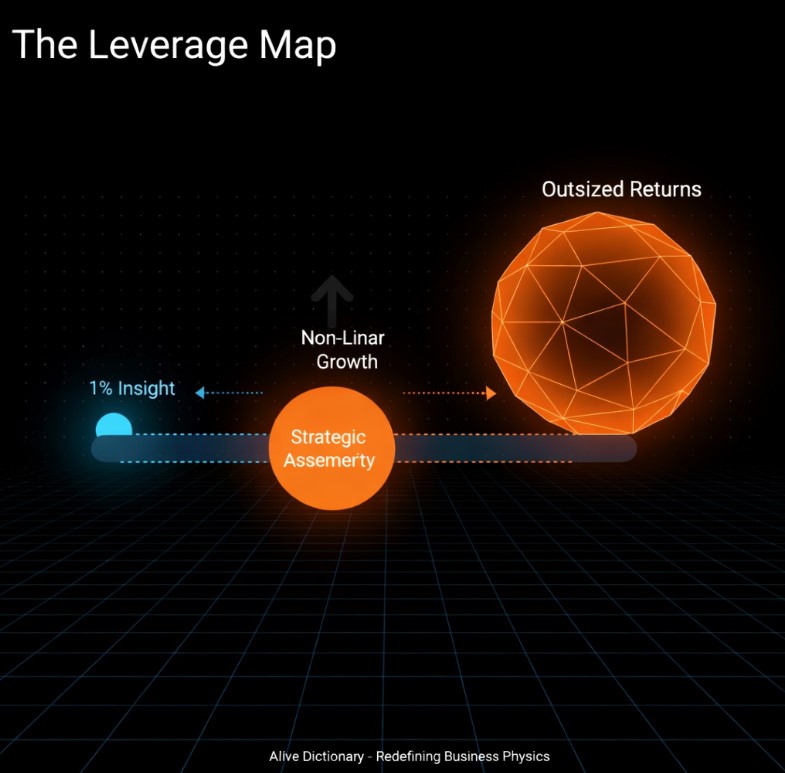
The Mechanics of Strategic Leverage
Linear systems are predictable: you add 1 unit of energy and get 1 unit of result. Asymmetry breaks this law. By identifying informational or structural imbalances, you position your “pivot point” to magnify your input.
- The Input: High-quality data, AI-driven insights, or specialized talent.
- The Pivot: Your unique organizational architecture (Asymmetry).
- The Output: Market dominance achieved with a fraction of the traditional cost.
Key Examples in Context
- Information asymmetry affects market decisions.
- The agreement created an asymmetry of power.
- Biological asymmetry is common in nature.
- Small actions can produce asymmetric results.
In high-level discourse, Asymmetry is used to highlight unbalanced outcomes or advantages.
1. Career & Personal Growth
“Writing online creates asymmetric upside: the downside is a few hours of work, while the upside is a global network and infinite opportunities.”
2. Business & Startups
“The startup exploited information asymmetry to disrupt the market, knowing more about customer pain points than the legacy incumbents.”
3. Risk Management
“We must avoid asymmetric downside at all costs; saving 10% on costs isn’t worth a 100% risk of system failure.”
4. Investing & Finance
“Venture capital is a game of asymmetry. Most bets go to zero, but a single winner pays for all the losses a thousand times over.”
Semantic Field: Fine-Tuning the Meaning
To master Asymmetry, you must distinguish it from related technical terms. While they overlap, the precision of your choice signals your level of expertise.
Asymmetry vs. Convexity
- Asymmetry is the general state of imbalance. It describes the “what.”
- Convexity is the mathematical shape of that imbalance. If a situation is “convex,” the benefits accelerate as you succeed (e.g., a viral video).
- Insight: You look for asymmetry to find convex returns.
Asymmetry vs. Skewness
- Skewness is a statistical term describing a distribution that leans to one side.
- Asymmetry is the strategic application. A “positively skewed” project is one with asymmetric upside.
- Insight: Use “skewed” when talking about data; use “asymmetric” when talking about decisions.
Asymmetry vs. Leverage
- Leverage is a tool used to multiply your effort (e.g., using code or capital).
- Asymmetry is a characteristic of the opportunity itself.
- Insight: You apply leverage to an asymmetric bet to achieve massive results.
The “Opposite” Spectrum
- Symmetry: A “fair bet” where risk and reward are equal (e.g., a coin flip). An Agentic person avoids symmetry because it offers no structural advantage.
- Linearity: Where output is exactly proportional to input. (e.g., getting paid by the hour). This lacks the explosive potential of asymmetry.
Asymmetry in the Modern Context 2026
In 2026, the gap between “linear” effort and “asymmetric” results has widened. We no longer live in a 1:1 world; we live in a world of power laws and extreme outcomes.
1. The AI Leverage Gap
AI has created a massive information asymmetry between those who can orchestrate “agentic” workflows and those who perform manual tasks.
- The 2026 Reality: A single person using a specialized AI swarm can produce the output of a 50-person agency. This is asymmetric productivity — the input (one human’s intent) is vastly outweighed by the output (global-scale production).
2. Permissionless Upside
In the past, high-upside opportunities were guarded by “gatekeepers.” Today, asymmetry is permissionless.
- The Shift: Code and content (videos, podcasts, apps) are asymmetric assets. They cost nearly zero to replicate but can reach millions. In 2026, an Agentic professional focuses on building these assets rather than trading hours for dollars.
3. “The Great Bifurcation”
We are seeing a structural asymmetry in the job market.
- Low Asymmetry Jobs: Roles with “capped” potential (e.g., standard administrative work).
- High Asymmetry Jobs: Roles with “uncapped” potential (e.g., algorithmic trading, creative direction, niche consulting).
- Context: Professionals are now advised to “Barbell” their careers — keeping a stable income source while placing multiple asymmetric bets on the side to capture sudden growth.
Usage Insight: The 2026 “Asymmetric Bet”
The most common phrase in 2026 strategy meetings is: “Is this an asymmetric bet?” This asks whether the cost of a failed experiment is low enough to justify the potential of a massive breakthrough.
Grammar Notes: Structuring the Word
Mastering Asymmetry requires understanding its word family and how it functions in formal syntax.
1. Word Formation
- Root: Symmetry (from the Greek symmetria, meaning “measured together”).
- Prefix: a- (meaning “not” or “without”). In English, this prefix creates the direct opposite.
- Adjective:Asymmetric (or Asymmetrical).
- Usage: “He sought an asymmetric advantage in the negotiation.”
- Adverb:Asymmetrically.
- Usage: “The wealth in that sector is distributed asymmetrically.”
2. Countability
- Uncountable: Used when discussing the general concept or abstract state.
- Example: “Asymmetry is a core feature of modern warfare.”
- Countable: Used when referring to specific types or instances of imbalance.
- Example: “The economist identified several asymmetries in the trade agreement.”
Usage Patterns
- Pattern 1: information / strategic + asymmetry
- Meaning: A situation where one party has more knowledge or power than the other.
- Example: “The company exploited information asymmetry to secure a more favorable contract during the merger.”
- Pattern 2: exploit / leverage + asymmetry
- Meaning: Turning an unbalanced situation into a personal or professional advantage.
- Example: “Leveraging asymmetry in the market allowed the startup to grow rapidly with minimal initial investment.”
- Pattern 3: asymmetry + between / in + [noun]
- Meaning: Highlighting the specific area where an imbalance exists.
- Example: “There is a significant asymmetry in the risk-reward ratio of this new venture.”
Asymmetry in Daily Conversations
To see how asymmetry fits into natural speech, examine these dialogues across various professional and strategic settings:
- Professional Context:
- A: “How did the firm gain such an edge over its competitors?”
- B: “They identified a strategic asymmetry in the supply chain that no one else had noticed.”
- Reflective Context:
- A: “Why did you choose this investment over the others?”
- B: “It offered a perfect asymmetric upside — the potential for gain far outweighed the possible loss.”
- Strategic Context:
- A: “What is the biggest threat to this negotiation?”
- B: “The information asymmetry between us and the vendor; they know the technical flaws, but we don’t.”
- Economic Context:
- A: “How should we distribute the budget for these experiments?”
- B: “We should act with asymmetric intent, placing many small bets to find the one that yields a massive return.”
Asymmetry in Narrative: A Story of Transformation
To understand the power of asymmetry, let’s look at two professionals facing the shift toward AI-integrated workflows in 2026.
The Linear Trap (Symmetry)
Mark is a traditional consultant. He charges by the hour. For every $1,000 he earns, he must give up exactly one hour of his life.
- The Reality: His career is symmetric. His upside is “capped” by the number of hours in a day. If he gets sick or stops working, his income drops to zero. He is trading a finite resource (time) for a finite reward (money). This is a 1:1 ratio with no room for explosive growth.
The Agentic Strategist (Asymmetry)
Sarah is also a consultant, but she operates with an asymmetric mindset. Instead of only selling hours, she spends 20% of her time building “asymmetric assets.” She develops a proprietary AI-driven framework and publishes a series of deep-dive strategic playbooks online.
- The Transformation: Sarah has created Asymmetric Upside.
- The Downside: A few hours of work and a small hosting fee (limited and known).
- The Upside: One of her playbooks goes viral in a niche industry. Thousands of people download it while she is sleeping. A global firm sees her framework and offers her a high-value partnership.
- The Result: Unlike Mark, Sarah’s rewards are no longer tied to her time. She has leveraged the structural asymmetry of the digital age to turn a small input into a life-changing output.
The Takeaway
The story of Mark and Sarah illustrates the core of the Agentic philosophy:
- Mark plays a “fair” game, but a fair game has no leverage.
- Sarah uses Optionality to place many small, asymmetric bets.
- In the 2026 economy, Symmetry is a slow path to stagnation, while Asymmetry is the only true engine of transformation.
When NOT to Use This Word
Despite its utility in strategic discourse, Asymmetry is not a universal substitute for “difference.” Using it in the wrong context can make you sound overly academic or detached from the situation.
1. In Simple, Low-Stakes Comparisons
Do not use “asymmetry” for trivial physical or aesthetic differences where no strategic imbalance exists.
- ✗ Avoid: “I noticed an asymmetry between the size of these two coffee cups.”
- ✓ Use: “These two coffee cups are different sizes.”
- Why: Asymmetry implies a functional or structural consequence; if the difference doesn’t change the “game,” use simpler words.
2. When Describing Simple Preferences
Personal tastes and opinions are differences, not asymmetries.
- ✗ Avoid: “There is a deep asymmetry in our political views.”
- ✓ Use: “We have a fundamental disagreement on politics.”
- Why: Asymmetry suggests a lopsided distribution of power or information, not just a clash of opinions.
3. In Place of “Inequality” (Social Context)
While related, these words carry different weights.
- ✗ Avoid: “The asymmetry of wealth in the city is a major issue.”
- ✓ Use: “Wealth inequality in the city is a major issue.”
- Why: Inequality is a social and moral term used for fairness. Asymmetry is a technical and strategic term used for structural mechanics.
Synonyms and Antonyms
The Asymmetry “Power-Cluster” (Synonyms)
- Convexity (The Growth Curve):
Use this when the asymmetry is positive and accelerating. It’s not just unbalanced; it gets better the further it goes.- Agentic Context: “We are looking for convexity in our content strategy — minimal cost per post, but infinite viral potential.”
- Leverage (The Force Multiplier):
Use this when the asymmetry is created by a tool or system.- Agentic Context: “Software provides the ultimate leverage, creating a massive asymmetry between the coder’s effort and the user base.”
- Skewness (The Probability Tilt):
Use this when the “unfairness” is hidden in the odds.- Agentic Context: “The startup market has a massive positive skew; most fail, but the outliers define the entire industry.”
- Divergence (The Path Split):
Use this when two previously equal things start to move in opposite directions.- Agentic Context: “We are seeing a divergence between traditional labor and AI-augmented productivity.”
The Symmetry “Stability-Cluster” (Antonyms)
- Linearity (The 1:1 Trap):
The state where output is strictly capped by input.- Agentic Context: “Hourly wages are the death of wealth because of their inherent linearity.”
- Equilibrium (The Neutral Zone):
A state where all forces cancel each other out — no advantage exists.- Agentic Context: “In a perfect market equilibrium, there is no room for outsized profit.”
- Reciprocity (The Equal Exchange):
A social or legal balance where “this” equals “that.”- Agentic Context: “Healthy relationships rely on reciprocity, but business empires are built on asymmetry.”
The Strategic Contrast Table
| Category | The Goal (Asymmetry) | The Trap (Symmetry) |
| Effort | Low (Small Input) | High (1:1 Ratio) |
| Result | Explosive / Uncapped | Predictable / Capped |
| Risk | Controlled / Known | Hidden / Total |
| 2026 Value | High Leverage | Low Value |
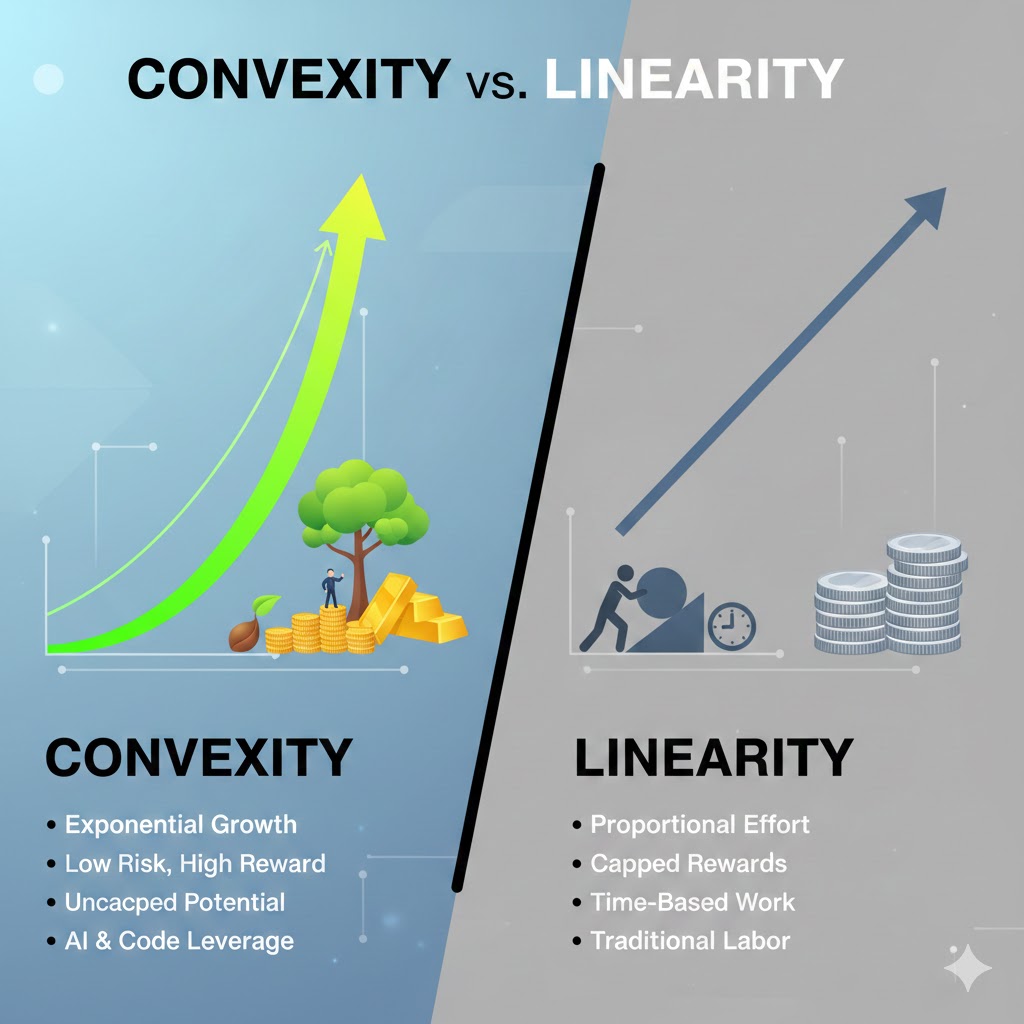
Asymmetric paths (blue curve) offer limited downside with explosive, uncapped upside potential.
Common Collocations: Professional Anchors
1. Adjective + Asymmetry (The “What”)
These describe the specific nature of the imbalance.
- Information Asymmetry: When one party knows more than the other (the most common usage in business).
- Structural Asymmetry: An imbalance built into the very design of a system or market.
- Asymmetric Risk/Reward: A scenario where the potential for loss and the potential for gain are not equal.
- Strategic Asymmetry: An intentional imbalance created to gain a competitive edge.
2. Verb + Asymmetry (The “How”)
These describe the action an Agentic individual takes regarding the imbalance.
- To Exploit Asymmetry: To take advantage of a lopsided situation for gain.
- To Leverage Asymmetry: To use an existing imbalance as a tool for growth.
- To Identify Asymmetry: The analytical act of spotting a “gap” before others do.
- To Hedge Against Asymmetry: To protect yourself from a situation where the downside is much larger than the upside.
The 2026 “Asymmetry” Cheat Sheet
To sound authoritative at a C2 level, use these precise combinations:
| Goal | Collocation | Example Sentence |
| Winning | Exploit information asymmetry | “We exploited information asymmetry by entering the market before the new regulations were public.” |
| Evaluating | Analyze the risk asymmetry | “Before we invest, we must analyze the risk asymmetry to ensure the downside is capped.” |
| Designing | Build structural asymmetry | “Our goal is to build structural asymmetry into our product, making it harder for competitors to copy.” |
| Protecting | Correct the asymmetry | “The regulator stepped in to correct the asymmetry between big tech and small creators.” |
Conclusion: Living on the Right Side of the Curve
In a world governed by power laws and rapid AI disruption, Asymmetry is the bridge between mediocrity and exponential success. If you play “fair” games (Symmetry), your rewards will always be limited by your time and effort. If you find and exploit “unfair” games (Asymmetry), your potential becomes infinite.
The Final Takeaway
Being Agentic means refusing to accept 1:1 ratios. It means looking at every project, investment, and relationship and asking:
- “Is my downside capped?”
- “Is my upside uncapped?”
If the answer to both is “Yes,” you have found Positive Asymmetry.
The 2026 Mandate
As we move further into the age of decentralized intelligence, the most successful individuals will be those who:
- Avoid Fragility: Eliminate “Negative Asymmetry” (risks that can destroy you).
- Collect Optionality: Accumulate as many “Positive Asymmetric” bets as possible.
- Apply Leverage: Use AI and automation to widen the gap between your input and the world’s output.
Summary at a Glance
- Asymmetry is the fundamental imbalance where small causes create large effects.
- Information Asymmetry is the currency of the modern elite.
- Convexity is the mathematical result of well-managed asymmetry.
- Your Goal: To transition from a Symmetric life (trading time for money) to an Asymmetric life (building systems that scale).
Frequently Asked Questions
Is asymmetry always a good thing?
No. Asymmetry is simply a structural imbalance. Whether it is “good” or “bad” depends on which side of the curve you are on:
Positive Asymmetry (Upside): Low risk, high reward. (e.g., publishing a book, applying for a dream job).
Negative Asymmetry (Downside): Small gain, catastrophic risk. (e.g., texting while driving to save 10 seconds, or cutting safety corners in a business).
What is the difference between Inequality and Asymmetry?
While both describe a lack of balance, the context is different:
Inequality is a social or moral term used to describe unfair distribution (e.g., wealth inequality).
Asymmetry is a technical or strategic term used to describe the mechanics of a system (e.g., information asymmetry in a negotiation).
How does Asymmetry relate to Optionality?
They are partners in strategy. Optionality is the tool you use to find and hold onto many different paths. Asymmetry is the filter you use to decide which of those paths are worth taking. You want options that have “asymmetric payoffs.”
Can asymmetry be “fixed” or “corrected”?
Yes. In many markets, the goal of regulation is to “level the playing field” by removing Information Asymmetry. For example, laws that require companies to disclose financial data are designed to protect investors from asymmetric disadvantages.
How do I find asymmetric opportunities in my own life?
Look for “low-cost experiments.” Ask yourself: “What is the absolute worst that can happen if I try this, and what is the best?” If the “best” is 100x larger than the “worst,” you have found a positive asymmetry.