
Quick Navigation
Core Concepts
The Opening
In an era of total digital noise, Cognitive Sovereignty has become the ultimate form of personal freedom. Have you ever caught yourself staring at a screen, realizing you didn’t choose to be there? Your thumb moved, a video played, and twenty minutes of your life vanished into an algorithmic void.
In the early 2020s, we worried about data privacy. In 2026, that battle is over. The new frontier isn’t who has your email address; it’s who has your agency. We have entered the era of the fight for Cognitive Sovereignty—the absolute right to own your own thoughts, impulses, and attention.
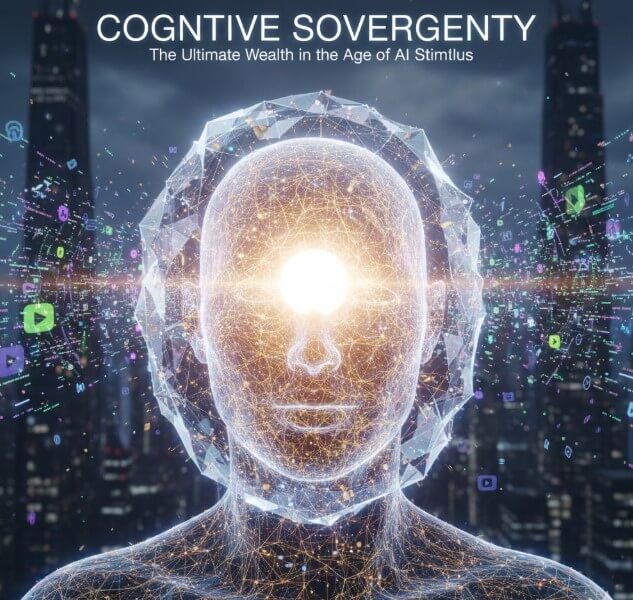
The Visual Metaphor of Agency
Look at the image above. In the era of Algorithmic Determinism, your mind is either the source of the light or a mirror reflecting the noise of the city. The crystalline shield you see isn’t passive; it is a result of active Neural Friction. It represents the moment you choose to pause, breathe, and act from your Private Interior rather than reacting to the digital storm outside.
The Death of the “Random Thought”
We used to have moments of boredom that led to genius. Today, AI-driven stimulus fills every micro-second of silence. The algorithm doesn’t just predict what you want to buy; it predicts your emotional state and “nudges” you before you even feel the spark of a new idea.
Cognitive Sovereignty is the wall we build to protect that spark. It is the realization that if you are not choosing your thoughts, someone (or something) else is choosing them for you.
This erosion of our internal space is the driving force behind what I previously described as The Ghost Economy. In that system, our presence is fragmented, and we slowly disappear into the noise of automated transactions and digital shadows, losing the very essence of our cognitive agency.
The disappearance of deep, spontaneous thinking isn’t just a feeling; it’s a documented shift in human attention spans. High-profile reports by The Verge on AI Evolution suggest that as we outsource our curiosity to predictive algorithms, we lose the ‘cognitive surplus’ needed for true innovation.
The Sovereignty Protocol: 3 Pillars of Neural Defense
To move from being a “user” to a “sovereign mind,” you must implement these three mechanical shifts:
- Protected Morning (The First Hour): Do not let an algorithm set your “frequency” for the day. No inputs, no notifications, no AI for the first 60 minutes.
- Purposeful Friction (The App Barrier): Make low-value stimulus hard to reach. If it takes 30 seconds to open a distracting app, your brain has time to ask: “Do I actually want this?”
- Private Interior (The No-Tech Sanctuary): Designate one physical space in your home where no silicon chips are allowed. This is where original thought is born.
From “Digital Detox” to “Neural Autonomy”
A “weekend in the woods” is no longer enough. The Static Era is persistent. To survive, we need a shift in mechanics:
- The Executive Filter: Learning to distinguish between an authentic desire (I want to learn English) and an algorithmic reflex (I am scrolling because I’m tired).
- The Private Interior: Creating mental “dead zones” where no device is allowed, specifically during the first and last hours of the day.
- Neural Friction: Intentionally making it harder to access low-value stimulus so your brain has the “friction” required to engage in deep, sovereign thinking.
To understand why a simple weekend without a phone is no longer enough, we must look at the CRITICAL Mechanics of Modern Attention Fatigue. The burnout we face in 2026 isn’t just about being tired; it’s a structural exhaustion of our neural capacity caused by the relentless friction of the digital world.
The mechanism of digital addiction is well-documented in modern neuroscience. Our constant engagement with AI-driven feeds creates a state of ‘continuous partial attention,’ which actively degrades our executive functions. Research available via the National Library of Medicine confirms that this overstimulation leads to structural changes in the brain, making the restoration of Cognitive Sovereignty not just a philosophical goal, but a physiological necessity.
Quick Audit: Is Your Mind Still Yours?
- Do you remember your last three “random thoughts,” or were they all prompted by a screen?
- Can you sit in a chair for 10 minutes without any digital input?
- Is your “Aura” being built by your actions, or is it being “farmed” by an algorithm?
If you answered “No” to any of these, your Cognitive Sovereignty is under siege.
To regain control, you must first measure the extent of the intervention. Beyond simple screen time tracking, we need to evaluate our ‘Attentional Autonomy.’ Resources like the Center for Humane Technology’s Toolkit provide practical frameworks for recognizing how persuasive design erodes our decision-making process. Use these insights to start your audit: are you clicking because you want to, or because you’ve been nudged?
The Sovereignty FAQ: How to Protect Your Mental Agency in 2026
Q: What is the primary threat to my mental agency in 2026?
A: The main threat is Algorithmic Determinism powered by hyper-personalized AI. Unlike the simple ads of the past, modern stimulus predicts your emotional vulnerabilities and “nudges” you into consumption loops before you can make a conscious choice. Protecting your agency is no longer about privacy; it’s about defending your independent thought process.
Q: How can I tell if my “Private Interior” is being compromised?
A: You are losing your Private Interior if you feel a “phantom itch” to check a device during every moment of silence. If your opinions, moods, and desires perfectly mirror your digital feed, your mind is likely operating in a predictive loop. Real sovereignty is the capacity for original thought that exists outside of a screen.
Q: Is “Neural Friction” better than a digital detox?
A: Yes, because Neural Friction is a long-term architecture for your life, not a temporary break. While a detox is a one-time event, friction-based design creates intentional obstacles—like removing biometrics or setting grayscale modes—that force your brain’s executive function to stay active and in control. (Note: Stay tuned for our deep dive on Neural Friction mechanics next week.)
Q: Can Cognitive Sovereignty actually improve my “Aura”?
A: Paradoxically, Sovereignty is the ultimate status symbol in 2026. In a world of reactive, overstimulated individuals, a person who possesses their own mind and moves with intentionality commands immense social capital. This “Passive Aura” of self-possession is far more attractive than the desperate need for digital engagement.
Q: What is the “First Hour Rule” for mental autonomy?
A: The First Hour Rule is the practice of remaining completely analog for the first 60 minutes after waking. Since the brain is highly neuroplastic in the morning, avoiding the “Digital Layer” during this window allows you to set your own cognitive frequency, preventing AI from hijacking your neural baseline for the rest of the day.
The Sovereign Lexicon: Terms You Need to Know
- Algorithmic Determinism — The psychological state where a person’s choices and moods are so heavily influenced by AI that their life path becomes a feedback loop created by code.
- Neural Friction — The intentional creation of obstacles to prevent mindless digital consumption and encourage deep focus.
- Attention Debt Recovery — The process of repairing the brain’s executive function after long periods of AI stimulus overload.
- Cognitive Agency — The measurable capacity to make a decision that was not influenced by a digital nudge or predictive notification.
The Final Choice In the coming years, the world will divide into two classes: the Determined and the Sovereign. One will live within a loop of perfect, comfortable prediction; the other will endure the friction of freedom. Cognitive Sovereignty is not a destination you reach, but a border you defend every single morning. The shield is in your hands. Use it.