
Alex Vibe | Growth Strategist • Updated: Feb 2026 • Exponential Growth Protocol
Table of Contents
Part of Speech & Pronunciation
- Part of Speech: Noun (Uncountable)
- Pronunciation:
- UK IPA:
/kəmˈpaʊnd.ɪŋ/ - US IPA:
/kəmˈpaʊnd.ɪŋ/
- UK IPA:
- Word Stress: Stress is on the second syllable: com-POUND-ing.
Register & Usage
- CEFR Level: C1 (Advanced)
- Register: Professional, Scientific, and Financial.
- Fields of Usage: High frequency in finance (compound interest), biology (population growth), personal development, and software engineering (technical debt/equity).
Core Definition
Compounding is a process where the value of an asset or the impact of an action increases exponentially because the gains from previous cycles are reinvested. Unlike linear growth (1, 2, 3), compounding follows a non-linear path (1, 2, 4, 8, 16), creating a “snowball effect.”
Quick Summary: Compounding is interest on interest applied to any area of life, from wealth to knowledge.
It answers the fundamental question: “How do small, repeated inputs grow into large outcomes?
Compounding in the 2026 Context
In the mid-2020s, the “Linear Trap” has become a career death sentence. As AI and automation handle routine tasks, the only way to stay relevant is to build assets that grow while you sleep. Here is how compounding has evolved:
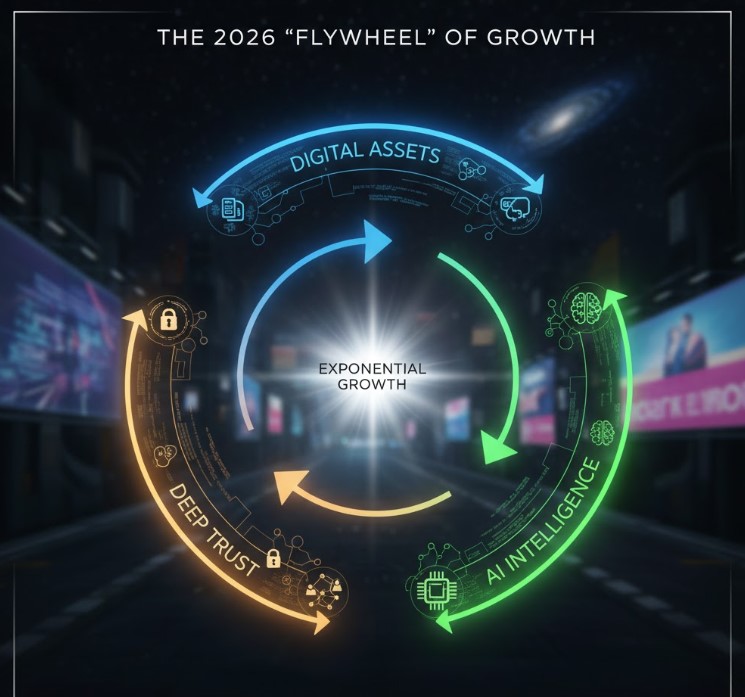
1. The AI Knowledge Loop (Algorithmic Compounding)
In 2026, we don’t just “learn” skills; we build Personal Knowledge Graphs.
- The Shift: Every time you feed your private AI model a new insight, a verified document, or a solved problem, your “Digital Twin” becomes more capable.
- The Result: Your ability to solve complex problems doesn’t grow by 1% — it multiplies because the AI connects your new data with everything you’ve recorded over the last five years.
2. Permissionless Media
Content is now the “Real Estate” of the 2020s.
- The Shift: A video, an article, or a piece of code is a “digital soldier” that works 24/7.
- The Result: We are seeing “The Long Tail” effect. A piece of content created in 2024 might finally hit a compounding inflection point in 2026 because the recommendation algorithms finally found its perfect “micro-niche.”
3. Reputation as a Currency
In a world of deepfakes and AI noise, Trust is the scarcest resource.
- The Shift: Consistency is the only way to verify identity. If you have been “on chain” or “in public” with high-integrity results for 1,000 days, your social leverage is 100x higher than someone who started yesterday.
- The Result: High-trust individuals can launch products, raise capital, or hire teams instantly. Their past compounding credibility removes all friction from future projects.
The 2026 “Flywheel” Diagram
Strategic Note: The Cost of Negative Compounding
In 2026, Negative Compounding is faster than ever.
- The Risk: Digital debt (messy files, outdated code, inconsistent branding) compounds at the same rate as success. If your system is “leaking,” the 2026 environment will magnify those leaks until they become a flood.
Grammar Notes: Mastering “Compounding”
1. Countable vs. Uncountable
- Uncountable (Common): When referring to the abstract process or phenomenon, it is uncountable.
- Example: “Compounding is a powerful force.” (Not “A compounding”).
- As a Gerund (Action): It often acts as the subject of a sentence.
- Example: “Compounding your gains requires patience.”
2. Adjective vs. Noun
- Compounding (Noun/Gerund): The process itself.
- Example: “The secret is compounding.”
- Compound (Adjective): Used to describe something made of two or more parts, or the result of the process.
- Example: “Compound interest” or “Compound effect.”
- Note: Avoid saying “Compounding interest” — the standard financial term is always Compound interest.
3. Transitive Verb Usage
“To compound” is a transitive verb, meaning it needs an object.
- Positive context: To increase or multiply.
- Example: “Daily reading will compound your knowledge.”
- Negative context: To make a bad situation even worse (very common in business).
- Example: “The CEO’s silence only compounded the PR crisis.”
4. Prepositional Patterns
- Compounding of [Something]: Example: “The compounding of small errors led to the system failure.”
- Compound with [Something]: (Rare, usually in chemistry or technical mixing).
- Example: “Substance A was compounded with Substance B.”
Quick Usage Checklist
| Correct | Incorrect | Why? |
| Compound interest | Compounding interest | “Compound” is the adjective for the financial term. |
| Compounding takes time. | The compounding takes time. | As an abstract concept, it usually doesn’t need “the.” |
| It compounded the problem. | It compounded to the problem. | “Compound” is transitive; no “to” is needed. |
Patterns: “Compounding”
1. The “Snowball” Pattern (Growth)
Used to describe a positive feedback loop where success breeds more success.
- Pattern: [Action/Asset] + creates a + compounding effect.
- Example: “Building an audience on LinkedIn creates a compounding effect; every new follower makes the next one easier to gain.”
2. The “Worsening” Pattern (Problems)
Commonly used in crisis management or technical discussions to describe mistakes that multiply.
- Pattern: [Mistake/Issue] + compounds + the [Problem].
- Example: “The lack of documentation compounds the technical debt, making it nearly impossible for new engineers to join the team.”
3. The “Time-Horizon” Pattern (Strategy)
Used when emphasizing that results aren’t immediate.
- Pattern: Allow + [Subject] + to compound + over [Time Period].
- Example: “The best strategy is to pick a niche and allow your reputation to compound over the next decade.”
4. The “Component” Pattern (Combining)
Used when mixing different strengths to create something superior.
- Pattern: Compounding + [Resource A] + with + [Resource B].
- Example: “Compounding deep technical skill with high-level sales is the rarest and most valuable talent stack today.”
Common “Power Pairs” (Collocations)
| Verb + Compounding | Adjective + Compounding |
| Accelerate compounding | Exponential compounding |
| Interrupt compounding | Intellectual compounding |
| Harness compounding | Negative compounding |
| Facilitate compounding | Automated compounding |
To make Compounding sound natural in your daily life, you need to move it from “math class” to “real-world strategy.” It is a word used by people who think in systems rather than single tasks.
Compounding in Daily Conversations
Here are the most common ways to drop “compounding” into a professional or high-level social chat without sounding like a textbook.
1. Discussing Personal Habits
Instead of saying “consistency is good,” use compounding to explain why it works.
- Situation: A friend asks how you stay so fit or knowledgeable.
- You say: “I don’t do intense sessions; I just stick to a 20-minute routine. It’s all about compounding small gains over months instead of burning out in a week.”
2. Talking About Career Growth
Use it to explain why you are staying in a specific industry or role for a long time.
- Situation: Someone asks why you haven’t switched jobs lately.
- You say: “I’m staying put for now. I’ve built deep relationships here, and I want to see that social capital compound before I move on to something new.”
3. Explaining Business Mistakes
Use it to warn someone that a small problem will become a disaster if ignored.
- Situation: A teammate wants to skip a small bug fix to save time.
- You say: “If we don’t fix this now, it’s going to compound. By next quarter, this tiny error will be a massive systemic issue.”
4. Networking & Influence
Use it to describe the “snowball effect” of knowing the right people.
- Situation: Discussing a successful entrepreneur.
- You say: “The first 500 customers were hard, but then compounding took over. Now, their existing users bring in new ones automatically.”
The “Social Cheat Sheet”
| When you want to say… | Use this “Compounding” phrase… |
| “It gets easier over time.” | “We are starting to see the compounding effect.” |
| “This mistake will hurt us later.” | “This will compound our problems down the road.” |
| “I’m learning a lot every day.” | “I’m focused on intellectual compounding right now.” |
| “Small steps matter.” | “Success is just consistency compounded.” |
Visualizing the Conversation
Note: When you use this word in conversation, you signal that you are a long-term thinker. It shows you understand that the big prize comes to those who wait for the curve to turn vertical.
Survival in the Valley: A Compounding Story
The “Valley of Disappointment”
Every story of compounding begins with invisibility.
Imagine two creators, Alex and Maya.
- Alex works in bursts of intensity. He spends a month working 18-hour days, launches a project, gets a spike of attention, and then burns out. He starts over from zero every time. This is Linear Living.
- Maya chooses a different path. She commits to just two hours a day, every single day. For the first six months, nothing happens. Her stats are flat. Her friends ask why she bothers. This is the “Valley of Disappointment” — where most people quit because the results don’t yet match the effort.
The Inflection Point
By Year Two, the curves begin to diverge. Alex is tired. He’s looking for the “next big thing.” But Maya’s small, daily efforts have begun to compound. Her old articles are being found by search engines; her early followers are now her biggest ambassadors; her skills have sharpened to a point of effortless mastery.
Suddenly, Maya hits her Inflection Point. In a single month, her growth exceeds everything she achieved in the previous two years. It looks like “overnight success” to an outsider, but it is actually the compounding interest of 730 days of discipline finally being paid out.
The Transformation
The story of compounding isn’t just about the end result (wealth, fame, or skill); it’s about the transformation of the character.
- Linear Alex is always chasing.
- Compounding Maya is now attracting.
By the end of the narrative, the system she built does the work for her. She has escaped the need to “grind” because her past efforts have created a self-sustaining vortex of opportunity.
The Moral of the Story
In any modern narrative — whether it’s a startup, a fitness journey, or learning a language — the protagonist wins not through a single heroic act, but through the unbreakable chain of small gains.
“Compounding is the only story where the ending is written by the person who refused to stop.”
When NOT to Use “Compounding”
1. When the process is actually Linear
If you are just doing the same task over and over without the results building on each other, it isn’t compounding.
- Don’t say: “I’m compounding my data entry work.”
- Why: Data entry doesn’t get easier or faster the more you do it; it’s just a repetitive task. Use “accumulating” instead.
2. When the result is a one-time “Spike”
Compounding requires time and reinvestment. If you get a sudden burst of luck or a viral hit that disappears tomorrow, that’s not compounding.
- Don’t say: “My TikTok went viral, the compounding is crazy!”
- Why: That’s a “spike” or an “outlier.” Compounding is the slow burn that happens after the spike if you manage to keep the audience.
3. In short-term projects
If a project lasts two weeks, there is no time for interest to accrue.
- Don’t say: “We need to see compounding growth in this 10-day sprint.”
- Why: Use “acceleration” or “velocity.” Compounding is a long-horizon game; trying to force it into a week sounds technically illiterate.
4. When referring to simple “Addition”
Don’t confuse “adding more things” with “compounding.”
- Don’t say: “I’m compounding my collection of sneakers.”
- Why: Unless your sneakers are somehow breeding or increasing each other’s value automatically, you are just “collecting” or “stockpiling.”
The “Cringe” Alert
Avoid using it to describe your personal relationships in a cold, mathematical way.
- Cringe: “Our friendship is really compounding this month.”
- Better: “We’re building a lot of trust lately.”
Synonyms and Antonyms
Synonyms: The “Growth” Family
Use these when you want to describe the same effect but with a different flavor:
- Snowballing: The most common casual alternative. (e.g., “The project is really snowballing now.”)
- Accruing: More formal/financial. Good for describing trust or interest. (e.g., “Trust is accruing in our brand.”)
- Multiplying: Use this when the growth is aggressive and fast.
- Cumulating: Focuses on the gathering or “piling up” aspect of things.
- Cascading: Great for describing a series of events where one triggers the next with increasing force.
Antonyms: The “Growth Killers”
These are the forces that stop or reverse compounding:
- Erosion: The slow, quiet wearing away of your progress. (e.g., “Inflation is the erosion of compounding.”)
- Decay: Natural loss over time. If you don’t maintain a skill, it decays.
- Stagnation: The “Flat Line.” When nothing grows and nothing builds.
- Friction: The “resistance” that slows the flywheel down (we should talk about this word next!).
- Dissipation: When energy or resources are scattered and wasted instead of being reinvested.
The “Word Swap” Guide
| If you want to sound… | Instead of Compounding, use… |
| More Casual | Snowballing |
| More Scientific | Exponential growth |
| More Financial | Accretive / Accruing |
| More Dramatic | A Chain Reaction |
Conclusion: The Long Game
Compounding is more than just a mathematical formula or a financial strategy — it is a philosophy of time. It is the bridge between who you are today and the exponential version of yourself in the future.
In a world addicted to the “instant” — instant messages, instant fame, and instant results — choosing to focus on compounding is a radical act. It requires the discipline to stay in the Valley of Disappointment while everyone else is looking for a shortcut.
The Final Word
The most powerful thing about compounding is that it rewards persistence over brilliance. You don’t have to be the smartest person in the room; you just have to be the one who refuses to stop. Whether it is your money, your skills, or your relationships, remember:
The greatest returns are always found at the end of the curve. Your only job is to stay on the path long enough to see them.
FAQ
1. What is the compounding effect in simple terms?
The compounding effect is a process where the gains from an activity or investment are reinvested to generate their own earnings. Over time, this creates a “snowball effect” where growth shifts from linear to exponential.
2. How long does it take for compounding to start working?
Compounding is invisible at first. Most people spend months or years in the “Valley of Disappointment”—a phase where effort exceeds visible results. The “breakout” usually happens at the Inflection Point, which depends on the consistency and frequency of your actions.
3. What is the difference between linear and compounding growth?
Linear growth is constant. It depends entirely on your current input.
Compounding growth is multiplicative: It builds on its own previous success, leading to much higher long-term rewards.
4. Can compounding work in a negative way?
Yes. Negative compounding happens when bad habits, debt, or technical errors build on each other. A small mistake ignored today can “compound” into a systemic failure or a “crash” in the future.
5. What is a “Compounding Flywheel”?
A flywheel is a metaphor for a self-sustaining compounding system. Once you put enough energy into starting the cycle (like building a brand or a product), the system gains its own momentum and begins to grow with much less effort from your side.
6. Why is consistency more important than intensity in compounding?
Intensity causes burnout, which interrupts the process. The “first rule of compounding” is to never interrupt it unnecessarily. Small, daily actions allow the math of compounding to work over time, whereas massive, irregular efforts often lead to stagnation.

“Compounding is the 8th wonder of the world. In 2026, it applies to your bank account, your vocabulary, and your Aura. The secret isn’t intensity; it’s consistency.”