
Quick Navigation
Core Concepts
The Ultimate Limit of the Human Psyche
In the high-stakes environment of 2026, where maintaining a perfect “Aura” is the norm, the term Crash Out has emerged as the essential descriptor for the moment the human psyche reaches its absolute limit.
Quick Definition: To “Crash Out” is to suddenly abandon all self-control, social filters, and long-term consequences in response to overwhelming stress or perceived injustice. It is a spectacular, often public, systemic failure of emotional regulation.
The Anatomy of a Crash Out: Why It Happens in 2026
Modern life has added new layers to this phenomenon. It’s no longer just a “meltdown”; it’s a socio-digital event.
- The Burnout Paradox: The relentless pursuit of productivity and “authentic” presence leads to mental exhaustion that eventually triggers an aggressive self-defense mechanism.
- Social Capital Risk: Unlike a simple argument, a Crash Out often involves the conscious destruction of one’s own reputation (loss of Aura) for the sake of immediate emotional catharsis.
- The “Unbothered” Mask: It is paradoxically most common among those who try too hard to remain calm for too long.
Crash Out vs. Emotional Outburst: Key Differences
Understanding the intensity of a Crash Out is key to recognizing it in modern culture.
| Feature | Crash Out | Emotional Outburst |
| Duration | Intense and often life-altering. | Short-lived and manageable. |
| Consequences | High risk of permanent bridge-burning. | Usually repairable with an apology. |
| Trigger | Result of months of suppressed stress. | Result of an immediate annoyance. |
| Aura Impact | Severe Loss. Catastrophic to status. | Minor Dip. Easily restored. |
| Behavior | Total loss of social filters. | Partial loss of composure. |
The Psychology: Why We “Crash”
Psychologists refer to this as Reactive Devaluation of status. When the weight of maintaining a persona (see Aura Farming) becomes heavier than the fear of being judged, the mind “crashes out” to reset the system. It is a violent way of regaining Autonomy when one feels trapped by external expectations.
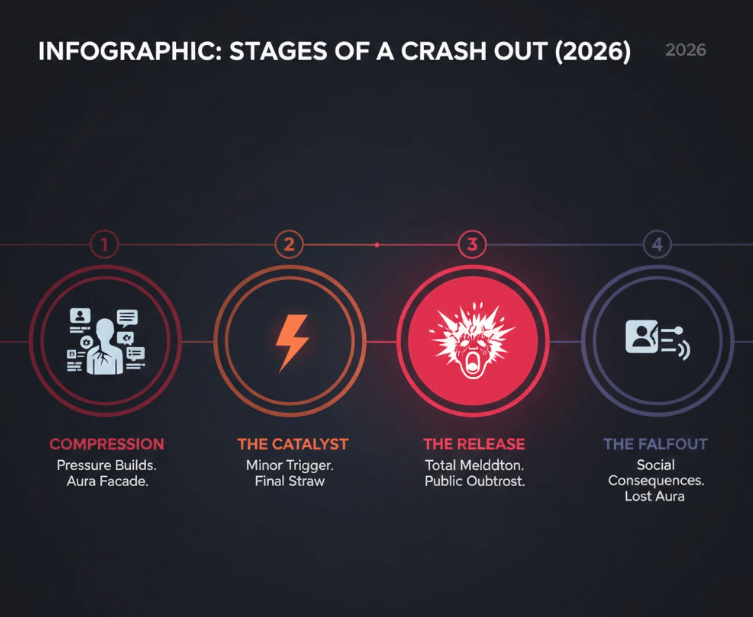
Stages of a 2026 Crash Out
- Compression: Suppressing feelings to maintain “Aura.”
- The Catalyst: A seemingly minor event that acts as the final straw.
- The Release: The actual “Crash Out” — usually vocal, public, or digitally permanent.
- The Fallout: The realization of the damage done to one’s social and professional standing.
Visualizing the Crash Out: From Pressure to Fallout
A step-by-step psychological map of a systemic emotional breakdown. Understanding these four stages — Compression, Catalyst, Release, and Fallout — is essential for identifying early burnout signs in 2026
Key Insights
- Root Cause: Accumulated suppression of emotions (The “Pressure Cooker” effect).
- Social Cost: Massive loss of “Aura” and social credit.
- 2026 Context: Often triggered by the exhaustion of maintaining a perfect digital persona.
Crash Out in Pop Culture & Social Media
- Digital Footprint: Mention how “Crashing Out” on live streams (TikTok/Twitch) has become a sub-genre of content, where the loss of Aura is traded for viral views.
- The “Crash Out” Aesthetic: Explain that while socially damaging, some subcultures romanticize the “crash out” as a moment of raw truth against a “fake” society.
FAQ: Understanding the “Crash Out” Phenomenon
Is “Crashing Out” always negative?
From a social standpoint, yes. However, it can be a “rock bottom” moment that forces an individual to rebuild their life with more Authenticity.
How do I prevent a Crash Out?
Early recognition of Digital Fatigue is key. According to studies on Emotional Intelligence, scheduled “manual reboots” through offline rest are more effective than forced composure.
Can you recover lost Aura after a Crash Out?
It is difficult but possible. It requires a period of “Radio Silence” followed by a consistent demonstration of new, grounded behavior.
Crash Out Culture: Key Terms & Definitions
- Crashing Out — A sudden, often reckless transition from chronic stress to a total loss of inhibition. It’s the moment a person stops caring about the consequences of their actions due to emotional overload.
- Social Breaking Point — The specific threshold where an individual’s internal “social debt” or digital fatigue exceeds their ability to maintain a polite or functional facade.
- The “Nothing to Lose” Paradox — A psychological state triggered by Burnout 2.0, where the brain perceives the destruction of one’s social or professional reputation as less painful than continuing to endure the current stress.
- Pre-Crash Volatility — A period of high irritability and emotional “fraying” that precedes a crash out. In 2026, this is often visible through abrupt digital detoxes or erratic social media behavior.
- Emotional Redline — The absolute limit of a person’s executive function. Beyond this line, the brain switches from “rational processing” to “primitive survival/aggression.”