
Table of Contents
Core Definition
One-Sentence Essence: Friction is any force — psychological, operational, or mechanical — that resists movement, slows execution, and dissipates energy within a system. It answers the question “What is causing resistance or slowdown?”
The Strategic Difference: In 2026, the cost of Friction is no longer linear; it is exponential. While competitors focus on adding “more power” (speed), market leaders focus on “removing friction” to achieve effortless Velocity.
Why Friction Defines Success in 2026
In the hyper-accelerated landscape of 2026, raw power — whether in the form of capital, AI compute, or human talent — has been largely democratized. When everyone has access to the same “engines,” the winner is no longer the one with the biggest motor, but the one with the least drag.
In this era, Friction has evolved from a physical nuisance into a strategic tax that determines the survival of organizations and the efficiency of individuals.
Key Examples in Context
- In Physics & Mechanics:
Friction occurs when two surfaces interact, converting kinetic energy into wasted heat. In any engine, this represents a direct loss of efficiency and potential power.
- In Strategic Management: Bureaucracy and redundant layers of approval act as institutional friction. This “organizational drag” slows down decision-making and prevents a company from reacting to market changes.
- In Team Dynamics: Lack of clear communication creates social friction. This results in “emotional drag,” where team energy is spent on resolving internal misunderstandings instead of productive execution.
- In User Experience (UX): Every unnecessary step in a digital journey — like an extra form field or a slow loading page — is a friction point. High friction leads to “user drop-off” and lower conversion rates.
- In Digital Transformation: Modern autonomous systems are often hindered by legacy friction. This happens when high-speed AI workflows are forced to wait for slow, manual human interventions.
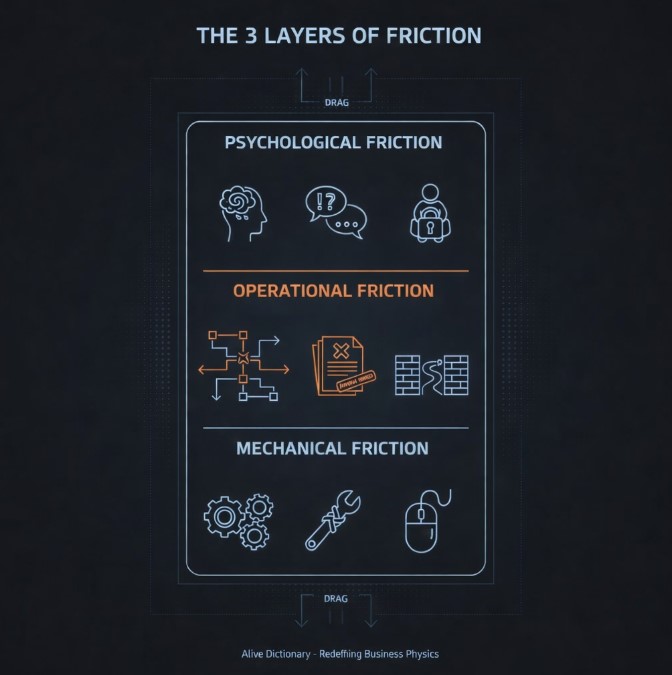
To effectively eliminate resistance, a strategist must identify its origin. Friction rarely exists in a vacuum; it operates in three distinct layers:
- Mechanical Friction: The base layer. This is about your stack — slow software, broken APIs, or outdated hardware. If the tools don’t work, the system fails.
- Operational Friction: The process layer. This is “Red Tape ” — unnecessary approval chains, redundant meetings, and bureaucratic loops that slow down execution.
- Psychological Friction: The human layer. This is the most expensive form of friction — doubt, lack of trust, cognitive overload, and misalignment of intent.
The Knowledge Web: Internal Connectivity
Friction does not exist in isolation; it is the “antimatter” to strategic progress. To master the Alive Dictionary ecosystem, one must understand how Friction interacts with our other core pillars. In 2026, the most effective leaders do not look at Friction as a single problem, but as a variable that degrades every other asset in their system.
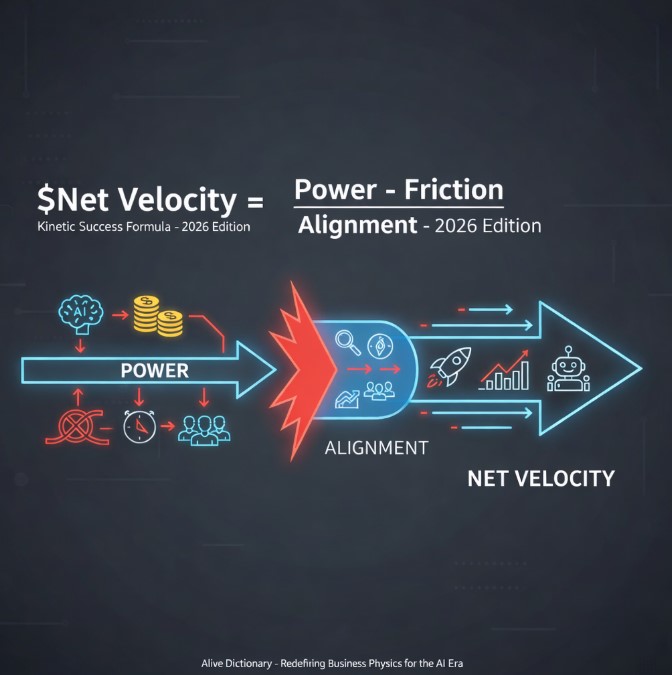
This formula redefines the physics of modern business: Net Velocity – the speed and direction of your progress – is not simply a function of Power (resources, talent, capital, AI compute). It is profoundly impacted by the Friction you eliminate and the Alignment you maintain within your system. Ignoring these variables means investing in a powerful engine that can never achieve its true speed.
1. Friction & Velocity
Friction is the primary denominator of Velocity. While speed is simply how fast you move, Velocity is speed in a specific direction. Friction acts as the “drag” that pulls you off course or slows you down.
The Law of Kinetic Success:

2. Friction & Acknowledgement
In human systems, the highest source of friction is the “Uncertainty Gap.” When a message is sent but not acknowledged, the system stalls. Acknowledgement acts as the high-grade lubricant of communication. By closing the loop instantly, you remove the social friction of “waiting for confirmation,” allowing the team to maintain momentum.
3. Friction & Agentic Systems
Passive systems require constant external energy to overcome friction (e.g., a manager constantly pushing a lazy team). An Agentic system is “self-lubricating.” Because it is proactive and self-correcting, it identifies friction points — such as a broken API or a missing resource — and resolves them autonomously before the system comes to a halt.
4. Friction & Compounding
Friction is the silent killer of exponential growth. Compounding requires a long, uninterrupted runway. Even a 1% “Friction Tax” on your daily progress can prevent the “elbow” of the curve from ever forming. To achieve exponential results, you must eliminate the daily micro-frictions that force you to “restart” or “re-calibrate” your efforts.
Applied Scenarios: From Theory to Execution
To master the removal of friction, one must recognize its manifestations in high-stakes environments. In 2026, friction is rarely a loud “stop” signal; it is a quiet, persistent “drag” on resources.
1. In Strategic Leadership: The “Decision Latency” Trap
In many organizations, friction is disguised as “due diligence.”
- The Scenario: A junior lead identifies a market shift and needs to pivot. However, the internal policy requires four levels of executive sign-off and a legal review.
- The Friction: Every hour spent in the “waiting state” is friction that bleeds the company’s Velocity.
- The 2026 Solution: High-performance leaders reduce friction by establishing Agentic protocols — clear boundaries where teams are empowered to act without seeking permission, effectively “lubricating” the decision-making chain.
2. In Technology: The Transition to “Zero-UI”
In software development, every additional click or form field is a friction point that reduces user retention.
- The Scenario: An AI application requires the user to manually input data, select a model, and then refine the prompt three times to get a result.
- The Friction: This is “Cognitive Friction.” The user must exert mental energy to manage the tool rather than achieve the goal.
- The 2026 Solution: Modern tech stacks focus on “Frictionless UX.” By using proactive, agentic workflows, the system anticipates the user’s intent, pre-filling data and executing tasks in the background, reducing the interaction to a single Acknowledgement.
3. In Product Growth: The “Onboarding Wall”
The gap between a user’s interest and their first “Aha!” moment is the most dangerous friction point in business.
- The Scenario: A SaaS platform forces a 20-minute tutorial and a credit card entry before the user can see a demo.
- The Friction: This is “Entry Friction,” which acts as a filter that only the most desperate users will pass through.
- The 2026 Solution: Companies achieve exponential growth by removing all front-end friction — allowing immediate, “friction-free” access to the core value proposition and delaying administrative requirements until the user is already hooked.
The Friction Audit: A Leadership Check
Before ending a meeting, a 2026 strategist asks one final question:
“Does this new process we just created add value, or does it simply add Friction to the person doing the work?”
Usage Patterns
The word Friction shifts its meaning depending on the “register” (the professional environment) in which it is used. In 2026, mastering these patterns is key to precise communication.
1. Technical & Engineering Register
In this context, friction is a neutral physical variable. It is something to be calculated, measured, and compensated for in design.
- Key Phrase: “Coefficient of friction.”
- Usage: Focuses on heat, wear, and mechanical resistance.
2. Strategic & Business Register
Here, friction is almost always negative. It is treated as a “waste” or a “tax” on productivity. Executives use the term to describe anything that slows down the path to profit.
- Key Phrase: “Reducing friction in the funnel.”
- Usage: Focuses on efficiency, speed, and profit margins.
3. UX & Product Design Register
In design, friction is a psychological barrier. It refers to the “cognitive load” placed on a user. Designers aim for “frictionless” experiences, but sometimes add “positive friction” (like a confirmation pop-up) to prevent errors.
- Key Phrase: “Frictionless onboarding.”
- Usage: Focuses on user behavior, clicks, and mental effort.
4. Diplomatic & Social Register
In human relationships, friction describes interpersonal tension. It is the heat generated when two differing opinions or personalities work together without proper alignment.
- Key Phrase: “Internal friction between stakeholders.”
- Usage: Focuses on culture, trust, and communication.
Quick Usage Guide
| Context | Instead of saying… | Try saying… |
| Growth | “The process is slow.” | “The process has high operational friction.” |
| Software | “The app is hard to use.” | “There is too much cognitive friction in the UI.” |
| Leadership | “People are arguing.” | “We need to address the social friction in this team.” |
Antonyms & Counter-Concepts
- Flow
- The Concept: While friction is resistance, Flow is the state of effortless movement. In psychology and operations, Flow occurs when the challenges of a task perfectly match the skills of the performer, and all “drag” (distractions, doubts, technical hurdles) is eliminated.
- Strategic Goal: Moving from a “Friction-heavy” culture to a “Flow-state” organization.
- Lubrication (Mitigation)
- The Concept: The active process of reducing resistance. In business, lubrication isn’t oil; it is Acknowledgement, clear documentation, and automated protocols.
- Strategic Goal: Identifying where friction is inevitable and applying the right “lubricant” to prevent heat (burnout).
- Superconductivity
- The Concept: Borrowed from physics, this refers to a material that allows energy to pass through with zero resistance.
- Strategic Goal: In a 2026 context, a “Superconductive Team” is one where an executive decision is translated into action instantly, without loss of intent or energy across departments.
- Catalyst
- The Concept: An element that increases the rate of a reaction without being consumed itself.
- Strategic Goal: Using Agentic AI as a catalyst to bypass traditional friction points in data processing.
Common Misconceptions (Friction Myths)
To be a true expert, you must distinguish between common myths and the 2026 reality.
| The Myth | The 2026 Reality |
| “Friction means we are being thorough and careful.” | Friction is waste. Accuracy should be built into the system (Guardrails), not added as a delay (Friction). |
| “Hard work always involves high friction.” | Friction is not effort. You can work incredibly hard on a frictionless task and achieve 10x the results. |
| “We need friction to control the team.” | Friction is a failure of trust. Control should come from Alignment, not from making things difficult to do. |
Grammar Notes & Usage
Understanding the nuances of Friction ensures it is used with precision in professional and technical contexts.
1. Syntactic Functions
- As a Noun (Common): Most frequently used to describe a force or a state of conflict.
- Example: “We must identify the source of friction in our onboarding process.”
- As an Adjective (Attributive): Often combined with other nouns to create compound strategic terms.
- Example: “The goal is to reach a frictionless state of operation.”
- As a Verb (Rare): While “to friction” exists in technical engineering, in business and strategy, we use verbs like reduce, eliminate, or mitigate friction.
2. Common Collocations
To sound like a native professional in 2026, use these standard pairings:
- Reduce/Eliminate friction: To remove obstacles.
- Internal friction: Conflict within a team or organization.
- Cognitive friction: The mental effort required to use a tool.
- Friction-free: A process that is perfectly smooth.
3. Countable vs. Uncountable
- Uncountable: When referring to the general concept or force.
- “There is too much friction in this department.”
- Countable: When referring to specific instances or points of resistance.
- “We have identified three major frictions in the user journey.”
4. Prepositional Usage
- Friction between: Used for two parties or surfaces. (Friction between departments).
- Friction within: Used for a single entity or system. (Friction within the algorithm).
Key Takeaways: Mastering Friction
If you only remember three things about Friction:
- Friction is a Strategic Tax: In any system — whether mechanical or organizational — friction is not just an annoyance; it is a measurable cost. If you do not actively manage it, friction accumulates and effectively “taxes” your resources, draining time, money, and energy before you can reach your goal.
- Friction Cannot Be Overcome by Brute Force: Attempting to speed up a process without first removing the friction only generates “heat” (burnout and stress). To increase your Velocity, you should focus on lubrication (simplifying the path) rather than acceleration (pushing harder).
- Frictionless is the Competitive Edge: In 2026, the most successful entities are those that are the easiest to interact with. Success is no longer about who has the most features, but about who provides the least resistance. Reducing friction for your customers and employees is the ultimate competitive advantage.
Conclusion: The Frictionless Frontier
In the landscape of 2026, Friction has transitioned from a physical concept to a definitive strategic metric. As we move deeper into the era of high-speed AI and autonomous systems, the gap between the successful and the stagnant will be measured by the resistance within their processes.
The most effective organizations and individuals are no longer those who work the hardest, but those who have built the smoothest pathways for their energy to flow. By identifying and eliminating institutional, cognitive, and social friction, you unlock the true potential of your resources.
- Friction is inevitable, but its accumulation is optional.
- Lubrication (Simplification) is more powerful than force.
- The Future belongs to the Frictionless.
Frequently Asked Questions about Friction
Q: Why is Friction considered the “Silent Killer” of business growth?
A: Because it is invisible until it is too late. Unlike a crisis (which is loud), Friction is a slow accumulation of inefficiencies — unanswered emails, redundant meetings, or complex approval chains. In 2026, friction acts as a “negative compound interest,” quietly destroying the benefits of Compounding before you even realize your growth has stalled.
Q: What is the difference between “Good Friction” and “Bad Friction”?
A: 95% of friction is “Bad” — it is waste. “Good Friction” is rare and intentional. It is designed to create a moment of pause for Safety or Clarity. For example, a “Confirm Transfer” button is good friction. However, requiring a team to manually update a spreadsheet that an Agentic AI could handle is bad friction that kills momentum.
Q: How does the concept of Friction relate to Velocity?
A: They are inversely proportional. You cannot increase Velocity simply by adding more speed or effort. To go faster, you must first remove the drag. If you add power to a high-friction system, you only generate heat (burnout), not motion. The most successful leaders focus on lubrication (removing obstacles) rather than acceleration.
Q: Is “Cognitive Friction” a real business metric?
Yes. It refers to the mental energy cost required to perform a task. In modern UX and leadership, high cognitive friction leads to “decision fatigue.” If a process requires a user or employee to think too hard about how to do the work, they will likely avoid doing it. The goal of the Alive Dictionary philosophy is “Zero-Cognitive-Drag.”
Q: What is the fastest way to eliminate social friction in a team?
A: The root cause of social friction is the “uncertainty gap” — not knowing if a message was received or understood. The antidote is Acknowledgement. By implementing a culture of instant, clear acknowledgement, you remove the emotional drag of “waiting and wondering,” allowing the team to move instantly to the next step.